Saturday 3 January
We were once more going to travel to The Gambia after visiting the previous year. With just six hours’ travel time and a direct flight from Gatwick Airport, it was a great way to get some winter sunshine and also to try out our new cameras (or in Andy’s case, my old camera). This time, however, we were also going to visit The Gambia’s neighbouring country, Senegal. The two countries share deep tribal connections through their major ethnic groups. Wolof, Mandinka and Fula tribes exist across both countries, as it was only artificial colonial borders that separated them. Senegal became a French colony, while The Gambia was a British one.
We travelled with Ascend Airlines, chartered by our travel agent, Gambia Experience. Unfortunately, there was a two-hour delay due to the late arrival of the catering. Having tasted the pappy toasted sandwich that eventually turned up for lunch, I would say they shouldn’t have bothered to wait!


We were staying at the Bakotu Hotel near Kotu Bridge in The Gambia, a new area for us as we had previously stayed in Kololi. Kotu was much quieter and more relaxed than Kololi. However, we couldn’t escape the usual mix of local touts, known as ‘bumsters’, who offer their services for tours, taxis, or anything a tourist might or might not need. By day two they all know your name, which hotel you’re in and where you’re from. On the whole it’s pretty light-hearted, although you feel you run the gauntlet each time you leave the hotel. They are all known by their unforgettable pseudonyms: Jack Sparrow, Mohammed Ali and Brown Snake Eagle to name but a few. This is a definite ploy so you won’t forget their names either. I’ve never shaken as many hands or taken as many cards as when walking around The Gambia. They work hard to get your business and you have to applaud their tenacity, particularly as they live in one of the poorest nations in the world.

We met up with Paul, a friend we had met on a previous holiday to Costa Rica, and were to join him and his bird guide, PJ, for the next two days. The morning did not start well, as PJ was nowhere to be seen at the agreed meeting time of 7am. Paul WhatsApped him with no joy. Finally, he phoned PJ, who was very tired and blamed Paul for taking him out for a late dinner after picking him up from the airport the previous night, but promised he would arrive soon.


We were to visit the Abuko Nature Reserve and the Lamin rice fields. PJ eventually arrived in a car he had purloined, which appeared reasonably roadworthy but displayed the typical array of dashboard warning lights that seem to be a feature of Gambian cars! However, it worked and had seatbelts, which was all we really needed.


Abuko Nature Reserve was The Gambia’s first nature reserve, protected since 1916 around the Lamin Stream and officially established in 1968. It has a field station, monkey and hyena orphanage enclosures, and a small market. We started with great sightings of three Violet Turacos. It is a beautiful, vibrant purple bird with a yellow forehead, chestnut crown, red eye surround and an orange beak. When it flies, you get to see its crimson underwings. Turacos are the only birds known to have true red and green pigments in their feathers; most other birds’ red and green colours are a result of light reflection.
We even spotted a small crocodile just breaking the surface of the water and a little bit too close to an unsuspecting African Jacana.

The bird hide is excellent for birds flying down from the adjacent trees to drink water. We saw African Paradise Flycatchers, waxbills, doves, African thrushes and one of my favourites, the Green Turaco, to name just a few.


A bonus was a visit from two genets, small spotted cats with long ringed tails. They are nocturnal and secretive, so it was a privilege to see them at such close quarters.


The dark foliage around the hide made photographing difficult and the seats are pretty uncomfortable, but if you sit long enough the variety of birds you see is amazing.


Lunch was chicken and chips, which were surprisingly very nice. The chicken was beautifully spiced.

In the afternoon we visited the Lamin rice fields, an agricultural area known for women farmers growing rice and vegetables. In the wet season, as the area floods, rice is grown in traditional paddies — a method dating back centuries. As the rains cease, these fields are then used to grow vegetables. Root vegetables such as sweet potatoes and yams are grown in mounds, as the soil is now dry and this improves drainage and aeration for better root development and yields.


The area is good for birds, particularly waders, and we were lucky enough to see a Dwarf Bittern — an uncommon, secretive and shy bird. We also saw herons and egrets including Squacco Heron, Black Heron and Striated Heron. There were also a great many different dragonflies in the area.


A downside to the afternoon was managing to stand on an ant nest. Somehow they managed to crawl up my trousers and bite my legs and it was quite painful. PJ was also affected and just when you thought you’d killed them all another one would bite. Ironically we were wearing long trousers and they never touched Paul and Andy in their shorts!
Driving back to our hotel, I was dismayed by the amount of litter everywhere. It is estimated that 75% of all plastic waste generated ends up in the environment. Without a developed waste management system, it is difficult to see this problem improving. I didn’t once see a public waste bin.
We passed by villages with typical compound structures enclosing several individual houses of the extended family. The buildings are often made of sun-dried adobe bricks, although you still see more basic wattle-and-daub structures with thatched roofs. The high cost of materials presents challenges for those wishing to improve their houses. The village is typically led by an Alkalo (village head) and a Council of Elders, including the local Imam (religious leader). These leaders handle land allocation, tax collection and dispute mediation. Cultural traditions remain strong, with storytelling, traditional music and dance forming an integral part of village life.
Along the roadside, small shacks manned by women sell local fruit and vegetables. Cashews and peanuts are also a familiar sight. There are the usual barber shops, bike repair areas and general stores. Traditional iron workshops are also commonplace and have a deep and significant history in The Gambia. They play an important part in the local economy. The traditional iron gates you see blend security with local architectural style, involving intricate hand-forging and geometric designs. Many gates are heavy and often rigged with a simple weight system (for example, a bottle filled with sand or a rock on a rope) to ensure they close automatically — a common example of Gambian resourcefulness.

As you drive along, children run alongside shouting and waving. They call out ‘Tubaab’, a Gambian name for ‘white people’. It is thought to derive from “two bob”, the slang name for a two-shilling coin in pre-decimal British currency. According to this theory, this was the typical amount paid to locals for performing odd jobs or running errands during the British colonial era.


We passed by beautifully dressed women in vibrant, colourful traditional kaftans and head wraps. In the country’s conservative Muslim culture, head wraps or hijabs form part of everyday women’s attire.

The towns are busy, with ubiquitous yellow taxis driving madly. Many look as though they are held together with string, and none appeared roadworthy. We often saw abandoned taxi carcasses littering the roadside, having eventually succumbed to the scrap heap. Larger vans also act as taxis, picking up and setting down passengers without any indication. Laden bikes and motorbikes weave around you, and traditional donkey-drawn carts are also part of the manic traffic. Let’s not forget the goats, cattle and chickens that roam freely as well. Driving myself would not be an option here.

We didn’t feel like dinner as lunch had been quite late and filling so just had a couple of beers before retiring to bed.
Sunday 4 January
We were out again with PJ and Paul, and this time we were visiting Farasutu National Park, one of the few remaining forest patches left in The Gambia. About a century ago, most of the country was reported to be covered by dense and almost impenetrable forest and was rich in wildlife, including a variety of large mammals such as hippos, waterbuck and roan antelope, as well as buffalo, giraffe, elephant and lion. The last three are now extinct in The Gambia.


The reserve really began when an Englishman, John Tucker, and his brother Peter were on a birding holiday in The Gambia in January 2009. While near the coast, the two got to know Kuloro and Farasutu and became involved in plans for a reserve there. The rest, as they say, is history, and the Farasutu Forest Community Reserve was born.

PJ was hoping to find the Grey-headed Bushshrike, a bird with beautiful yellow plumage. It proved elusive and although I saw it dive into the trees, I couldn’t get a photograph. There was plenty more to see here, though. Shikras, small agile birds of prey, flew overhead, as did shrieking Rose-ringed Parakeets.


There was a private bird hide here and PJ guaranteed us a Pygmy Kingfisher, the smallest kingfisher in Africa, as its name suggests. Birdwatching at the hide was slow; the overcast conditions meant birds weren’t so desperate to drink, so we had almost given up when it was spotted in a nearby bush. It was so small that at first I struggled to get my camera to focus.


Finally some birds appeared at the hide. First, a beautiful Bearded Barbet appeared — a strange-looking bird with a black bristly beard below its beak. It is a very colourful species, with a black crown, red belly and throat, and a distinctive yellow eye patch. Then a Shikra came down and decided it was going to commandeer the pool, which meant nothing much else was going to visit. So we moved on to another hide back in the Farasutu Reserve.
Things were slow there too and we were beginning to get hungry, so with lunch beckoning we made our way to Baobab Island.


It is not a huge island, but is known for its baobab trees and is situated in a river creek close to Kuloro village. It is just a short boat trip across the creek to access it. Sadly, it looked neglected despite its fantastic location. The restaurant was basic and empty, and the chicken and chips were not as good as the previous day’s. We weren’t even quite sure it was chicken, but PJ said they had forgotten we were coming and had to quickly find some birds to cook. Judging by their toughness, I suspect they were old laying hens that had outlived their usefulness.


There were lots of birds on the island and the place could have been amazing — it just needed some investment. PJ spotted a Klaas’s Cuckoo, a small iridescent green cuckoo in the trees. Like many cuckoos, it does not build its own nest or raise its own young; instead, the female lays a single egg in the nest of a host species, typically sunbirds or warblers.

Greyish Eagle-Owl


In the afternoon we were taken to see a pair of Greyish Eagle-Owls. At first glance they are difficult to spot, but eventually your eyes become accustomed and the owls begin to stand out among the branches. Unlike most owl species, they don’t have yellow eyes but dark brown ones.


Back at the Farasutu waterhole we spotted a Green-headed Sunbird, although its head looked more blue than green. There were also quite a few other birds, including the delightful Cordon Bleus, where the males sport vivid red cheek patches.


As we made our way back to our hotel, PJ began to tell us about his father who had served in the Second World War in Burma. He was part of the 81st (West Africa) Division, a force largely referred to as the “Forgotten Army”. Over 4,000 Gambians were conscripted and 288 killed. I hadn’t realised that the British government had taken soldiers from their colonies at the time. It must have been odd for these soldiers. Their feelings would have been complex.

Some soldiers volunteered because they saw themselves as part of the British Empire and felt a genuine connection and loyalty to Britain, which they considered the “Mother Country”.
For many from impoverished rural areas, the promise of regular pay and meals, especially a steady supply of meat, was a powerful incentive to enlist. recruitment was often handled by the local chiefs meaning there was community pressure to join up. The worst part must have been after the war when their contribution appeared to be forgotten as the government failed to recognise what they had done. However, the experience of war opened their eyes to the wider world and helped fuel the rise of independence movements.
In the evening there was a musician at the hotel playing a traditional kora. More like a harp than a guitar, it has 21 strings and is constructed from a calabash gourd and cowhide. Traditionally, you are taught by your father, and you can only learn if your father played — the skill is hereditary.

With only two restaurants to choose from outside the hotel (which didn’t have the best reviews), we headed once again for the pizza place. Of course, you can’t make it there on your own — there is always a ‘fixer’ to accompany you, and presumably he gets something from the restaurant for his troubles.
Monday 5 January
We got up early and went to the hotel viewing platform. There were lots of Little Bee-eaters flying around, catching insects. Today we were on our own, as Paul and PJ had started their tour of The Gambia and Senegal.


We walked down to the nature trail by the bridge. At present the bridge is not open and a new one is being constructed with Chinese backing. There was a lot of disruption and noise and I wondered whether it was affecting the birds in the area. The guides were certainly looking forward to it being finished.


Red-billed Hornbill


As we walked along we came across a pair of Rose-ringed Parakeets nesting in a dead trunk. Of course, these parakeets are the UK’s only naturalised parrot species, with a large and thriving self-sustaining population. However, somehow it is always nicer to see them in a country where they originated. There was also a pair of Blue-bellied Rollers on another dead branch, and we also spotted a pair of Broad-billed Rollers — rufous-cinnamon birds with chunky yellow bills.


In the afternoon we had booked a boat trip with Jack Sparrow along Kotu Creek. We waited while he emptied water from the bottom of the wooden boat — never a good sign, although I don’t think the creek is very deep. There were the usual noisy Pied Kingfishers; a pair were perched on the electric wires above us as we stood at the jetty.


We got into the boat and slowly made our way downstream. It was so quiet once you had left the jetty, and at that time we were the only boat on the creek, which was very pleasant. We saw Malachite Kingfisher and Giant Kingfisher, as well as cormorants, herons, egrets and curlews. There was even a huge monitor lizard climbing a tree. Black Kites are plentiful in this part of The Gambia, unmistakable with their forked tails and distinctive shrill whistles. They are always very vocal.

Kotu Creek is always full of birds, with its rich habitat of mangroves, mudflats, ponds and surrounding scrubland. This is especially true in the dry season.
There are two footbridges that cross the creek and these have to be navigated by boat. There is not a lot of headroom, so you have to bend down to prevent your head from being sheared off at the neck. Not so easy when you’re getting on in years, but we managed with heads safely intact.

We went to the Aroma Restaurant for food, as we preferred it to the pizza place because it served more authentic Gambian cuisine. Gambian food is a rich blend of West African flavours, with a focus on local ingredients such as fish, rice, peanuts, and fresh vegetables and herbs. Domoda is delicious and is considered the national dish. It is a rich, creamy stew made with concentrated peanut paste (groundnuts) and can be cooked with fish, beef or chicken. Yassa was another favourite; it features chicken or fish marinated in a zesty mixture of lemon juice, mustard, garlic and onions. Both dishes are served with rice and were very good value.


Tuesday 6 January
Today we tried to find the golf course trail, as it was supposedly good for birds, but failed. We ended up behind some industrial units, so gave up and went back to the bridge.


We decided to use the photographic hide with Lamin, another guide who cornered us as we were walking along. It’s a bit of a pain to get to, as you have to run the gauntlet of tyres. These are there because the ground is incredibly marshy, but although they are filled with sand they are not the easiest to navigate. One wrong step and you are up to your knees in mud.


The Painted Snipe that can be seen here were not very obliging and remained mostly hidden in the mangroves. However, we did see a Blue-breasted Kingfisher. These kingfishers are not reliant on water and are known as ‘tree kingfishers’, often living in densely wooded areas. Although they do eat fish, they mainly hunt insects. Its bill is two-toned, with a striking red upper mandible and black lower mandible. We also saw a Bronze-tailed Starling, a beautiful green and purple starling. It can be distinguished from Lesser and Greater Blue-eared Starlings by its purple, rather than greenish, tail.


Back at the hotel there were quite a few birds around the viewing platform and the surrounding trees. One of more interesting was a Northern Puffback a striking black and white bird with a distinctive red eye. It was catching bugs around the trees. There were also other small birds around, including a Cordonbleu and some waxbills. A White-crowned Robin-Chat also made an appearance. All in all, it was the most birds we had seen at the hotel.


Mohammed Ali was our fixer for the taxi into Kololi to eat at the African Queen restaurant, a place we had enjoyed on our previous visit to The Gambia. We had to walk up to the bridge because it was closed, and I assumed he would drive us. However, all he really did was try to find one of the waiting taxis for us — something we could easily have done ourselves. The first taxi driver was asleep and uninterested. The second taxi was being used for prayer, but luckily the third driver was willing.


It worked out well, as we agreed a price and he said he would come back in a few hours to pick us up. They didn’t even want any money up front, so we were fairly confident they would return. The restaurant was not as good as we remembered. The starter was lovely, but the main course was a bit bland. There is probably a moral to be found there somewhere. It was interesting to be back in Kololi and we realised just how much busier it was. A few things had changed even in a year, and the quaint Gambian bar we used to go to had disappeared, which was a shame.


I’ve often wondered why the country is called The Gambia rather than just Gambia. Apparently, in 1964, before it gained independence, its prime minister formally requested that the definite article “The” be used as part of the official name. This was done specifically to avoid confusion with the newly independent Northern Rhodesia, which was becoming Zambia. Mail was often mistakenly sent to the wrong country due to phonetic and spelling similarities. It is one of only two countries prefixed by “The”, the other being The Bahamas.
Wednesday 7 January
Today we chilled around the hotel. We walked down to the viewing platform to see what was about, but it was pretty quiet. Later we walked to the beach and ended up buying yet more bracelets and two plates of fruit. The fruit was a mistake, as we thought we were ordering juices, but of course we couldn’t say anything. I had already been given a card by “Moana no 2”, so I felt compelled to seek her out for our order. On the beach is where the ladies sell their wares such as shea butter, jewellery, or make up fruit plates or fruit drinks. They said they were struggling as it was very quiet and they hadn’t seen the tourists of previous years. The reality probably is that people in the UK haven’t got as much disposable income as in previous years, so holidays are one area where savings can be made.


Later we went down to the viewing platform again. We got talking to a couple of people who had also come to The Gambia for the birdlife. The guy was a policeman and had been involved in the investigation into the shooting of White-tailed Eagles. It was very interesting, especially as he thought they might be able to lift fingerprints off the tracking collar that had been cut off one of the birds. Having seen these magnificent birds at our local RSPB site at Pulborough Brooks, I had been particularly saddened by the killings. The main culprits tend to be people working in the game bird shooting industry.
There ended up being quite a few birds around, with some species we had never seen. The elusive Gonolek has been a bird that I have struggled to get a good photo of. You hear them as their call is very distinctive, but they don’t like coming out into the open. It’s a shame as they are striking birds. They are a black-and-crimson bushshrike with a yellow-orange crown. One was calling loudly to the side of the viewing platform where there were quite a few thick bushes and trees. It teased me a bit by showing itself briefly, but it was incredibly dark so I wasn’t able to view it properly.


There were also Fiddler Crabs crawling in the mud below the viewing platform. The males have a huge claw used for signalling. The beautiful Blue- breasted Kingfisher also made a welcome appearance. It’s similar to the Woodland Kingfisher, but separated by its larger size.
It was our last day in Gambia before we made the trip over into neighbouring Senegal. We decided to take only one case and leave the other at the hotel, as we would return here for the airport pickup at the end of the holiday.
Dinner was in Aroma once more, as the food was really good and cheap. The beer was pretty good in Gambia too, with the main ones being Cristal and Goldfinch. Only Goldfinch is locally brewed, as Cristal is imported, usually from Portugal. There was also another Kora player at the restaurant.

Thursday 8 January
We got picked up at 7 and taken to the port at Banjul. Our driver passed us over to a guy who would ride the ferry with us and then pass us on to another driver at Barra on the other side. We caught the Kunte Kinte ferry, a nod to the famous Roots book written by American author Alex Haley. The narrative begins in the late 18th century in the village of Juffureh, on the Gambia River in The Gambia, where Haley’s ancestor, Kunta Kinteh, was born and raised. Kunta Kinteh, a young Mandinka man, is born in Juffureh around 1750 and grows up in a Muslim family. In 1767, while gathering wood for a drum, he is captured by slave traders and sold to a Virginian plantation owner. Today there are tours you can take visiting the compound of the Kinte family’s descendants and the local Museum of Slavery, housed in an old colonial warehouse. You also get taken to Kunta Kinteh Island, which was used as a holding pen for captured slaves before they were transported to Gorée in Senegal and then onwards to the Americas.


The ferry across the mouth of the Gambia River to Barra took about 30 minutes, and we were lucky enough to get seats on the top deck. Thankfully our guide was able to lift our big bag up the two flights of metal steps. Halfway through we passed the other ferry. It is both a passenger and vehicle ferry and is a vital transport link across the river, although it can be unreliable due to maintenance and operational challenges. There weren’t too many tourists on board, mainly locals, often with large bags and baskets containing goods to sell in Banjul. The fare is only 35 dalasi, about 35 pence, so incredibly cheap. There were also vendors selling goods onboard.
Our guide told us to wait a bit for most people to get off before we disembarked. I was so relieved we had only packed one big case, as I’m not sure how we would have coped with two. He strode ahead, wheeling our bag, and we followed through the chaotic melee of people. We cut through a busy market with food stalls cooking up rather nasty-looking pieces of meat. I’m sure I spotted a jawbone complete with teeth in one of the large metal trays they were cooking in. Ladies balancing heavy bags and baskets walked as though their loads weighed nothing. This amazing skill is learnt in early childhood through imitation and constant practice. Loads start light, but gradually the weight is increased over time. The skill is perfected out of necessity, as head carrying is the most efficient, hands-free way to transport goods in many rural areas. The need to use their arms for other tasks reinforces the practice. Over time, the women develop tremendous balance, posture control, and the necessary neck and core muscles, making the action feel natural and efficient.
Finally we made it to our driver. He was incredibly tall and almost had to fold himself into the front seat. We struggled to find our seatbelts in the back, but he just smiled and said, “No seatbelts, this is an African car!” It was about 15 minutes to the Senegal border. The border was a bit manic, as is always the case. Our driver was busy picking up paperwork for the car while we showed passports and yellow fever certificates, joining the queues with other locals. Then it was another fifteen minutes to Fathala Lodge.
We arrived to find it raining and rather cold. It felt like we were going to spend a break at Chessington World of Adventures rather than in Africa. Our rooms weren’t quite ready as we had arrived in Senegal quickly. Fathala Lodge is luxury tented accommodation located within the Fathala Wildlife Reserve. The reserve itself spans 6,000 hectares of protected forest, home to zebra, giraffe, warthogs, rhino and antelopes, as well as a plethora of birdlife.


Finally our rooms were ready and we were led along the wooden boardwalk to tent number 8. We realised almost immediately that we had forgotten the plug adaptor. Unlike in The Gambia, where the sockets were UK ones, these were the two-pin European type. Without a way to power up our batteries, phones, iPads and watches, this was a disaster. However, luckily they had one. They even gave us our own router to take around the lodge with us, with 2 GB of data (which doesn’t last very long, as we were to find out!). There are 20 tents on site, each with air conditioning, a four-poster bed, private deck, flushing toilet, freestanding bath, twin basins and an open-air shower. We even had a jacuzzi!


Having missed breakfast we were pretty hungry so ordered a couple of toasties that were huge. They would definitely stave off any hunger pangs before dinner.
At 4 we did a game drive with Marie. We saw Red Patas monkeys, often called the military monkey for their reddish coat and long limbs. We also saw Western Giant Eland, the largest antelope in the world and one of the most endangered, with Fathala home to nearly half of the remaining population. There were warthogs, bushbuck, waterbuck, zebras and giraffe, as well as Roan antelope with striking black-and-white facial masks – not as dark as a sable. For the first time we saw West African Forest Buffalo known for its reddish-brown coat and smaller stature compared to savannah buffalo. These social herbivores, often found in small herds, thrive in the reserve’s protected, dense forest environment. We also saw a White Rhino nicknamed Kevin, who had supposedly killed his mate when she refused his advances.


The waterhole in front of the lodge was like a beautiful stage where animals entered to drink. It made for an interesting view as we ate dinner. The food was excellent and there were two choices on each of the three courses.

Friday 9 January
Today we were due to visit a Senegalese fishing village on an island and then another island in the Saloum Delta, where our guide would prepare lunch for us. The Saloum Delta is a UNESCO Biosphere Reserve and World Heritage Site.

It turned out that the first village was our guide’s home village. Senegalese traditional, or artisanal, fishing is a cornerstone of the nation’s economy and food security, but it faces an existential crisis, primarily due to overfishing by foreign industrial fleets. This has led to severely depleted fish stocks and profound socio-economic problems for local communities. The traditional boats are very colourful and made of wood, known as pirogues. They are long and narrow, often curved like a banana. Similar to canoes, they have a flatter, fuller bottom, making it easier to navigate shallow coastal waters and river deltas. Originally built from a single log, these days they are assembled from planks of West African redwood. They are painted by hand, often in the colours of the Senegalese flag – green, yellow and red. Blessings and the names of holy people are often painted on them in the Wolof language, and many boats also feature painted “eyes” on the hull for protection against evil forces.


The village was obviously very poor. Some of the young men from the village had left to make the illegal and dangerous boat journey to the Canary Islands in Spain, primarily because of the collapse of the local fishing industry and a general lack of economic opportunities and social mobility in Senegal. The Atlantic route to the Canary Islands is currently considered the world’s deadliest migration route. If they do make it, family members living abroad who send remittances back home often gain more respect and status. This creates a social expectation and pressure to seek a better life elsewhere, captured by the popular phrase “Barcelona or die”. They travel in crowded, often unseaworthy traditional pirogues with limited food, water and fuel for journeys that can take weeks. The route spans around 1,500 kilometres of open Atlantic Ocean, making it extremely dangerous. Thousands are estimated to die or go missing at sea each year. The success rate is low, and even those who arrive often face an uncertain future in Europe.
At the time there was no electricity in the village, as the solar panels had no working batteries and the generator was broken. Rubbish was a real problem, as it had been in The Gambia. There is inadequate waste management infrastructure, a high reliance on single-use plastics, and insufficient public awareness. Our guide said they did organise litter picks, but there wasn’t much sign of it.
The village had a primary school and a clinic with a nurse, as well as a mosque. Our guide showed us his house, which was stone-built and quite large, with some nice mahogany furniture pieces, but very basic. Food preparation was being done by his wife, sitting on the floor in a hut in the garden. Vegetables were being cut and fish scales scraped, with a fire in the corner to cook on, so conditions were extremely basic. We then met his mother. With only 500 inhabitants, everyone knew him.


We returned to the boat and stopped off on the beach of another island, where there were some basic seats and shelter from the sun. The wind had picked up, so although we could have swum, we decided not to. We were made some barbecued chicken, with rice and a nice salad. It was very chilled. On the way we caught sight of an osprey, a common bird in this area.
Back at Fathala Lodge there was another lovely meal waiting for us. The waterhole was full of animals, and the white rhino also came to visit, chasing off the warthogs so he could roll in the mud by himself.
Saturday 10 January
It was an 8am start for a bush walk. We started off with a short drive into a more forested area. It was lovely to walk in the cool morning and stretch our legs a bit. One disadvantage of safari holidays is that you are mostly in a vehicle, so it was nice to be on foot for a change. Of course, here we didn’t have to worry about any lions attacking us.


We saw a Pearl-spotted Owlet and quite a few other birds – two Violet Turacos, a Brown Snake Eagle, Senegal Parrot and a Pygmy Sunbird. The call of the Pearl-spotted Owlet is the one all the bird guides use. It has a very distinctive sound: an accelerating series of rising “fwooo” notes followed by descending “puuueeeww” whistles, which attracts the bird out into the open. Unfortunately, we didn’t see any mammals, just a far-off waterbuck running through the trees.
The Fathala forest is home to iconic trees such as the African Baobab and African Mahogany. The Fathala Wildlife Reserve within the forest is run by a private South African company. Hopefully this means it will remain safe from deforestation. “Fathala” actually means “Do not touch” in Mandinka.
We walked to the pick-up point, where the safari vehicle met us for coffee and biscuits before taking us back to the lodge.


In the afternoon, a troop of Patas monkeys came down to the waterhole. They are the fastest primates on land, capable of reaching speeds of up to 34 mph (55 km/h). They are ground-dwelling monkeys, unlike the Red Colobus that we also saw around the lodge. They have a beautiful reddish coat and often a distinctive white moustache. They will occasionally eat bird eggs and lizards, as they are omnivores. Unfortunately, they are listed as “Near Threatened” on the IUCN Red List due to habitat loss and hunting.


The Red Colobus are the most threatened group of primates in Africa. Their babies are born with pure white fur, which gradually changes to adult coloration after a few months. This unique colouring is believed to encourage “alloparenting”, where other females in the group help raise the infant. The name “colobus” comes from the Ancient Greek word kolobós, meaning “mutilated one”, referring to their highly reduced, almost absent thumbs. This adaptation helps them swing swiftly through the trees, using their long fingers like grappling hooks. They are primarily leaf eaters, often able to digest poisonous leaves that other animals cannot.


The third primate around the lodge were the Green Vervet monkeys. They are known for their sophisticated, predator-specific alarm calls. Researchers have identified over 30 different calls that vervet monkeys use to communicate within their troops, along with various body gestures and facial expressions. Infants are born with black hair and white faces, and as with the Patas monkeys, this also encourages “alloparenting”.


Sunday 11 January
It was nice just to relax around the lodge, and it gave us the opportunity to watch the different groups of animals coming to the waterhole. In the dry season it was a very valuable resource. Birds also flocked there, particularly Vinaceous and Laughing Doves. Another dove we spotted frequently was the Red-eyed Dove, one of which was making a nest of sticks on top of the glass doors of the lodge’s communal area.


Starlings were the other common birds here, and they may be common, but they are particularly beautiful. They belong to the group known as glossy starlings, and their feathers are iridescent. This iridescence is caused by the physical interaction of light with microscopic structures in their feathers rather than by pigments. The effect varies depending on the viewing angle, so the perceived colour shifts, appearing as metallic hues of blue, green, purple and bronze. In poor light the birds can appear dull or almost black. These gregarious birds were all around, with the most visible being the Long-tailed Glossy Starling.


As we were sitting under the shade of a parasol on the deck overlooking the waterhole, we spotted a Palm Vulture in one of the trees. It is a unique bird of prey, as it is the only primarily vegetarian vulture, with a diet consisting mostly of the fleshy husks of oil and raffia palms. While many vultures have bare heads, its head is fully feathered as it does not feed on rotting carcasses. The bare skin patch around its eyes can change in intensity from orange to bright red, influenced by its diet and even its mood. It remained in the tree for ages and we nearly missed it when it finally flew down for a drink.


A troupe of Red Colobus descended into the lodge feeding high in the trees. As they went from tree to tree their ability to leap over large distances was incredible.. They are so highly specialised arboreal primates. They rarely descend to the ground relying on a form of locomotion called semibrachiation – using their arms to swing from branch to branch combined with powerful leaping.


There was also another visitor to the waterhole: a a large Nile Monitor Lizard. It is Africa’s largest lizard and can grow to nearly 8 feet long.

There was also a group of Patas Monkeys playing around the lodge and a group of warthogs making the most of the muddy end of the waterhole to have a mud bath. They lack sweat glands so this wallowing enables them to regulate their temperature. It also helps to protect their skin from the sun and in parasitic control.


We did an evening game drive with Marie as our guide once more. This time we were joined by two German girls also staying at the lodge. We came across a small herd of West African Forest Buffalo. They are the smallest of the African buffalo subspecies and have a distinctive reddish-brown coat, which helps them camouflage in the dappled light of the forest, unlike the darker Cape Buffalo of southern and eastern Africa. They also have smaller, backward-curving horns that rarely fuse at the base.


We then came across a small herd of zebra. Marie asked us whether we thought a zebra was a black animal with white stripes or a white animal with black stripes. Most of us chose the latter, but she said it had to be a black animal with white stripes, as it was African. A zebra’s skin is actually all black underneath its fur. The white stripes come from hair that lacks pigment (melanin), while the black stripes contain melanin. The zebras in Fathala are Burchell’s Zebra, and no two zebras have exactly the same stripe pattern, much like human fingerprints.

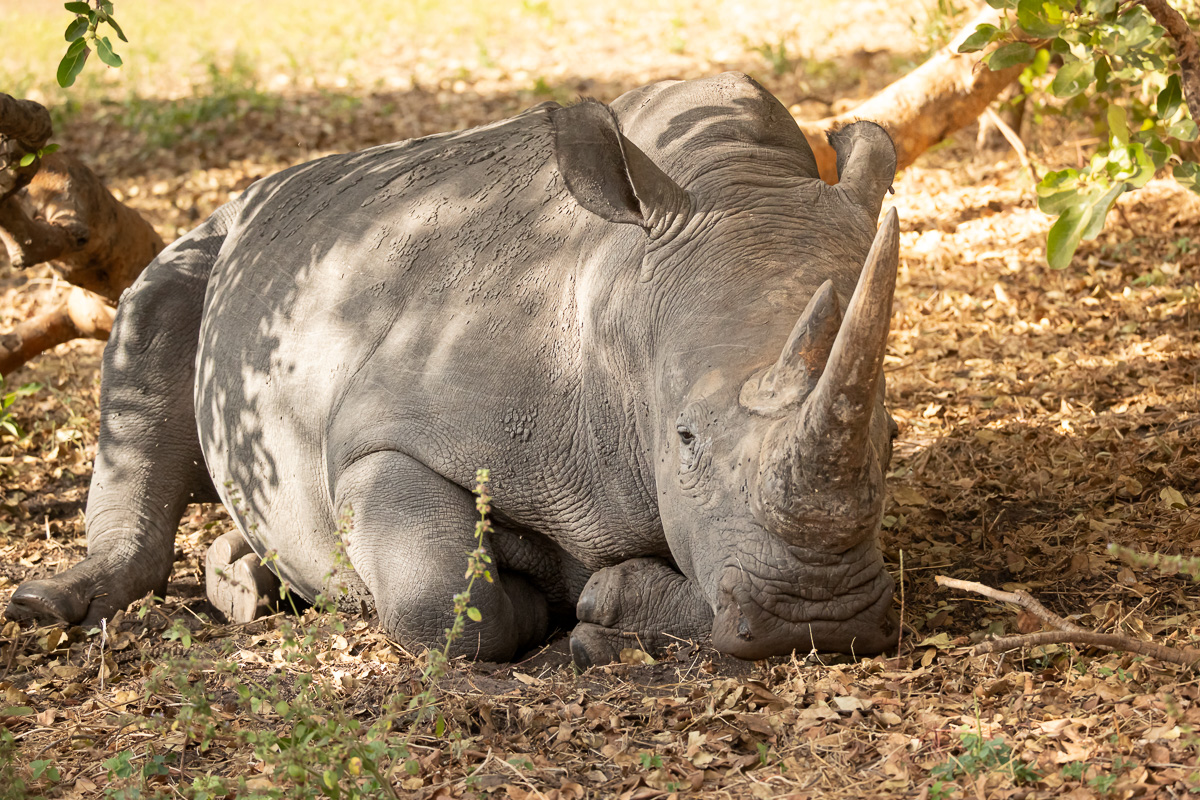
We then spotted the white rhino feeding alongside some warthogs. Despite the name, white rhinos are the same grey colour as black rhinos. The “white” is believed to be a misinterpretation of the Afrikaans word wyd (or wijd), meaning “wide”, which refers to their broad, square-shaped mouth. It is hoped that a mate can be found for him, as it must be a lonely and solitary life.

Back at the lodge there were quite a few Giant Eland by the waterhole. In the night, with just the lights of the waterhole, these huge antelope, with their dewlaps (the hanging skin on their necks), looked almost like enormous long-legged lions from the side. As they walk, a sharp clicking sound can be heard, thought to be caused by the slipping of a tendon over a knee or foot bone. This sound can travel a great distance and may help the herd keep track of one another. They are classified as critically endangered, with only a small population remaining in protected areas in Senegal, and over half of that population is in the Fathala Forest.

At night we also noticed lots of bats flying around, often skimming the swimming pool, presumably for insects that had fallen in. These were Angolan Free-tailed Bats, which are insectivorous and a common sight.
Monday 12 January
Our mangrove boat trip wasn’t until 4, so we had plenty of time to sit and watch the animals at the waterhole and to walk the length of the boardwalk to see what birds were about. Literally as we stepped out from our tent, a pair of Vieillot’s Barbets flew by, instantly recognisable by their red heads. There was also a small group of francolins disappearing into the bushes. Of course, I was too slow to photograph either.


Mid-morning, a giraffe rather tentatively walked towards the waterhole. The giraffes here are South African, or Cape Giraffes, translocated from South Africa to the reserve, as the native West African giraffe subspecies had disappeared from the area. Like zebras, no two giraffes have exactly the same pattern. Their dark blue tongues can be as long as 20 inches. They don’t sleep much, mainly because they need to eat constantly. It finally came to drink, splaying its legs so that it could reach the water. A few hours later we spotted it sitting. I had never seen a giraffe sitting before and wondered if it had a problem, but apparently they will sit to rest, particularly if they feel safe, although it is unusual to see.


The mangrove tour took us back down the same straight sandy road we had travelled on before during the island trip. This led us back down to the Saloum Delta once more. The delta is a vast and biodiverse ecosystem. The entire delta is part of a Biosphere Reserve spanning approximately 180,000 hectares, comprising a complex network of meandering creeks, known locally as “bolongs”, over 200 islands and islets, mangrove forests, and an Atlantic marine environment. It is a critical stopover for migratory birds and home to over 200 resident species. There was a chance of seeing dolphins, but unfortunately we were unlucky. There are even turtles and manatees here.


Pied Kingfishers were everywhere, whether sitting on overhanging branches or hovering over the river. We spotted an Osprey on a low-hanging branch, so the guide cut the engine and we floated quietly towards it before it finally took off. There were plenty of cormorants and whimbrels. The tide was high, so we didn’t see some of the birds that would normally inhabit the mudflats. We did see Intermediate and Giant Egrets. There were also Pink-backed Pelicans, which are resident breeders and common in the delta. One tree was full of them. Sacred Ibis were also present, often roosting in the trees. This species was revered in Ancient Egypt and associated with the god Thoth, the deity of wisdom and writing. They were once common in Egypt but are now locally extinct there.


Blue-cheeked Bee-eaters seemed to perch on every available branch. They are pretty lime-green birds and clearly do well here. The scenery is beautiful and it’s incredibly quiet. Beyond the mangroves, huge baobab trees dominate the skyline. Fallen baobab trees are home to countless oysters, which are a vital source of food and income for local communities in the Saloum Delta region. Harvesting is a traditional activity primarily undertaken by women. The oysters are collected at low tide and consumed fresh or processed by cooking or smoking before being sold in local markets. The accumulation of oyster shells over thousands of years has formed large “shell mounds”, or middens, in the delta. These are significant archaeological sites that provide insight into the history of human settlement in the area.


We stopped and slowly glided along while our guide produced some wine and snacks. We were with the two German girls again, and they were describing their journey to Senegal via Brussels to Dakar, a very roundabout trip for them. I was appreciating the direct flights we had to Banjul.


On our way back, our guide needed to pick something up from the village where he lived, so we had another opportunity to see it from the boat. A few fishing boats were out, and on one moored by the bank they were clearly cooking the fish they had caught over an open fire. It looked terribly dangerous, as the whole boat could go up in flames, but apparently they do it all the time. By the river’s edge in the village, the piles of oyster shells were clearly visible, forming quite a substantial bank.
Tuesday 13 January
It was our last day and really just about getting home. The border back into The Gambia was fairly straightforward, with our driver once more being helpful and efficient. He dropped us at Barra port, where we were met by the same guy who had taken us on the ferry on the way over. This time the ferry was almost ready to depart and was incredibly busy. We had worried that any delays might mean we would miss our flight, so we were very relieved to get on this one.


Because it was so full, our guide motioned for us to go into a covered area on the lower deck. Here there were long wooden benches along either side, and the windows were blacked out with tarpaulin, probably to keep the area cooler. Every available inch of bench space was taken and we were tightly packed in. It wasn’t a particularly pleasant experience, as you couldn’t see where you were going and we were sitting right next to the huge lorries, with the constant noise and smell of engines. The ferry lurched and vibrated as it pulled away, adding to the sense of being crammed into a working transport rather than a tourist crossing.

As we made our way across the river, there was a steady procession of vendors squeezing through the narrow aisle, selling everything from underwear and toothbrushes to snacks and drinks. Most of the passengers were women, presumably travelling to Banjul to sell their goods, many balancing bags and baskets with remarkable ease despite the crowded conditions. It was uncomfortable, but at the same time a vivid and very real glimpse of everyday life, colourful, noisy and full of movement.
Eventually the ferry docked, and it was a relief to step back onto dry land. Finding our driver was straightforward, and he took us back to our original Bakotu Hotel. From there it was just a waiting game until our coach arrived to take us to the airport.
: