Friday 17 July 2026
It was an early start to get to Gatwick for our easyJet flight to Kraków. A 3:20 am alarm, to be exact! Everything went very smoothly at Gatwick – easyJet have a slick operation. It was just a couple of hours before we landed at Kraków Airport. As we came in to land, I noticed lots of military aircraft, as the airport also operates as a dual-use military airfield.
Unfortunately, passport control was incredibly busy, with queues of people slowly snaking their way towards the booths. Those still in the EU were whisked through the automated passport scanners with no problems at all, while us Brits could only look on in envy. It took over an hour and a half to get through, and we were worried our pre-booked transfer to the hotel wouldn’t wait. Luckily, he did.
We were staying at Hotel Xerion, which turned out to be a charming boutique hotel. Our room was small but well appointed, and one of just eight arranged around a central atrium.
As our room was ready, we dumped our luggage and set off to explore Kraków, with a cool beer first on the agenda. Our destination was Bar Gwar. On the way, we crossed the Father Bernatek Footbridge with its incredible balancing sculptures. These suspended acrobat figures are unique because they use the laws of physics to create the illusion that they are balanced on just one or two points. As the bridge moves, the sculptures gently sway too, making them seem almost lifelike.


The bridge has also become the focus of a romantic local tradition, where couples attach padlocks engraved with their initials to the railings before throwing the keys into the river below to symbolise their eternal commitment. It is split into two lanes, one for cyclists and one for pedestrians, and links the historic Jewish quarter of Kazimierz with the district of Podgórze. The bridge is named after Father Laetus Bernatek, a 19th-century monk who spearheaded the construction of the nearby Brothers Hospitallers Hospital in Kraków.

There was also a small dragon at the foot of the bridge. I later found out that there is a Dragon Trail and there are others to find.

Kraków is Poland’s second-largest city and lies on the banks of the Vistula River. It was the nation’s capital until 1596. Its Old Town was declared a UNESCO World Heritage Site in 1978 and, remarkably, escaped the widespread destruction suffered by many other Polish cities during the Second World War.

Bar Gwar
We stopped to admire the austere Gothic-style Corpus Christi Basilica, whose stunning gold interior is in complete contrast to its plain exterior. The striking 1750 pulpit is shaped like a golden boat supported by mermaids, while the enormous gilded high altar sits beneath Kraków’s largest pipe organ. Built in the 15th century and founded by King Casimir III the Great, the basilica also boasts a towering 70-metre freestanding bell tower. It stands in striking contrast to the predominantly Jewish heritage of the surrounding area.


Swifts shrieked overhead as they circled the tower, and I soon spotted the familiar silhouette of a peregrine falcon. The lofty bell tower clearly provides an ideal home for these magnificent birds.


Outside in the church grounds there was an interesting sculpture installation called the ‘Stations of the Cross’. The abstract bronze figures represent Christ carrying the cross through the 14 stations of the cross. Rather than depicting realistic people, the sculptor created stylised figures with outstretched arms that resemble crosses. These emphasised suffering and sacrifice.


Our next stop was Schindler’s List Passage. This narrow, historic, whitewashed alleyway was used by director Steven Spielberg as one of the principal filming locations for the harrowing scenes depicting the liquidation of the Kraków Ghetto in 1943.

Adjacent to the passage was what turned out to be our favourite place for a beer. All the seating was outside beneath a huge tree that provided welcome shade from the hot sun. They also served some delicious cakes.


Next, we wandered into Plac Nowy, known as the Jewish Square, with its bustling flea market. At the centre stands a distinctive circular brick pavilion dating from the 19th century. Built in 1900 as a market hall, it later served during the 1920s as a ritual poultry slaughterhouse for Kraków’s Jewish community.

There were plenty of stalls selling Polish amber. Poland is recognised as a global powerhouse for Baltic amber, often called the “Gold of the North”. It is sourced primarily from the Baltic Sea near Gdańsk and is formed from fossilised tree resin around 40 million years old. Amber has long been intertwined with Polish history, craftsmanship and trade.
There were also numerous stalls selling military memorabilia. The tables were piled high with an eclectic mix of Second World War and Soviet-era items, including old army uniforms, helmets, badges and medals.

After such an early start, we were beginning to feel tired, so we wandered back towards our hotel and had something to eat at one of the floating boat restaurants moored on the river beside the footbridge.


Saturday 18 July 2026
We started off after a hearty breakfast at the hotel. Our first stop was the Wawel Dragon Statue. Before reaching it, we took the short tour through the limestone cave known as the Dragon’s Den beneath Wawel Castle. According to legend, this is where the dragon lived – a fearsome beast that devoured cattle and local maidens. We descended the 135 steps down a spiral staircase into the cave. Inside, you can hear the dragon roar and see dragon shadows cast onto the cave walls. Once outside, we found ourselves beside the Wawel Dragon Statue, where we waited for the dragon to breathe fire.


The 14th-century Wawel Castle served as the official seat of Polish kings for centuries. It is a fascinating mix of architectural styles arranged around an elegant arcaded courtyard. We explored the castle grounds, which are completely free to enter. We found the confusing array of ticket options rather off-putting, so decided not to go inside. Instead, we relaxed in the grounds with a refreshing homemade lemonade.


Alongside the castle sits Wawel Cathedral. It is particularly striking because of its mixture of chapels and royal burial chambers, including the stunning gold-domed Sigismund Chapel.


Next, we headed to St Michael the Archangel Church, also known as the Church on the Rock. Built in the 18th century, it is considered one of Kraków’s finest Baroque churches. Outside is the Well of Saint Stanislaus where, according to legend, the dismembered body of the bishop was thrown by King Bolesław before miraculously reassembling. Nearby stands the Altar of the Three Millennia, with statues representing seven important figures in Polish history. Unfortunately, much of the interior was covered by restoration work, so we couldn’t appreciate it fully.


We passed by the church of the Saints Peter and Paul, a historic Roman Catholic baroque church built in the 16th century. It has a magnificent white Dolomite stone frontispiece. It is instantly recognisable by the row of Stone sculptures of the 12 apostles that line the front gates.


ChatGPT had planned our walking route after we’d explained what we wanted to see. Unfortunately, our recommended lunch stop didn’t open until 2 pm! As the day went on, we also began to feel the route wasn’t particularly well planned, as we seemed to be walking backwards and forwards rather than following a natural route around the city.


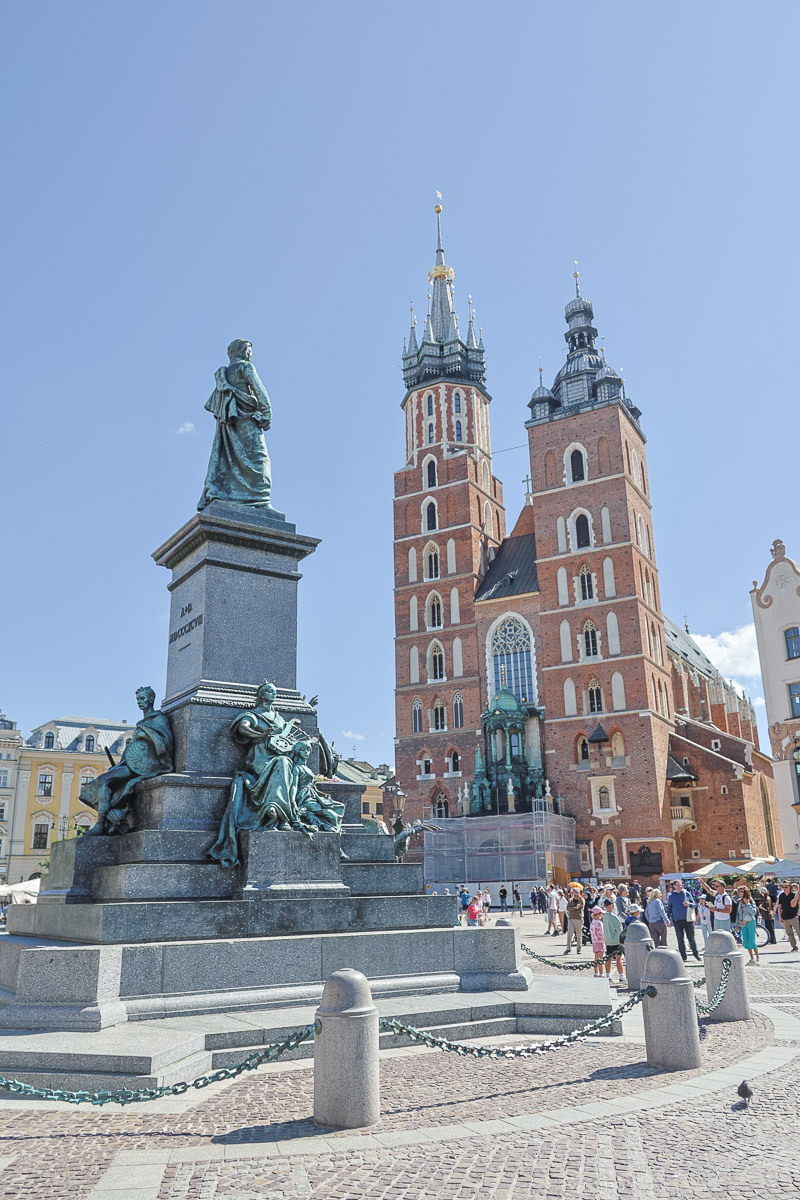
We then made our way to the Main Market Square (Rynek Główny). Laid out in 1257 after the Mongol invasions had destroyed much of the city, it is the largest medieval town square in Europe. Around it stand many of Kraków’s most iconic landmarks, including St Mary’s Basilica, the Cloth Hall, the Town Hall Tower and the Church of St Adalbert.


We visited the 14th-century St Mary’s Basilica. We had to queue for tickets, but it was well worth the wait. Sitting on the north-eastern corner of the square, it is instantly recognisable by its two towers of unequal height. The taller tower was historically used as a watchtower and is crowned with an ornate Gothic spire.


However, it is the interior that truly takes your breath away. A riot of colour, the vaulted ceiling is painted deep blue and covered with golden stars. Intricate medieval stained-glass windows and magnificent murals decorate the walls. The undisputed highlight is the enormous wooden altarpiece. Carved over twelve years, it is the largest Gothic wooden altarpiece in the world, measuring 13 metres high by 11 metres wide. It consists of five panels containing around 200 exquisitely carved figures. The sculptor is said to have used the residents of medieval Kraków as models for many of the faces. The central panel depicts the death of the Virgin Mary, shown kneeling in prayer surrounded by the twelve apostles. When the wings are opened, they reveal six scenes representing the Joys of Mary.


During the Second World War, the altarpiece was dismantled and hidden in crates at various locations. The Nazis eventually discovered it and transported it to Germany. Following the war, it was returned to Kraków and painstakingly restored.
The Town Hall Tower is all that remains of the medieval town hall, which was unfortunately demolished during the 19th century. Standing 70 metres tall, it was built around the turn of the 14th century. It has a noticeable lean after a violent storm in 1703 shifted the structure by around 55 centimetres.

The square is filled with horse-drawn carriages offering tours of the Old Town. Their elegant white carriages looked as though they had come straight from a fairy tale, while some of the horses had the most extraordinary markings. The white horses covered in black spots belonged to the distinctive Knabstrupper breed. Their beautiful Dalmatian-like coats are caused by the Leopard Complex gene. They were absolutely stunning.


We then wandered through the centre of the square to the Cloth Hall and its traditional wooden market stalls. It has served as a centre for international trade for more than 700 years. After the original building was destroyed by fire in 1555, it was rebuilt in its magnificent Renaissance style, with the elegant arcades being added during the 19th century.

Our next destination was the medieval courtyard of the Jagiellonian University. Despite our best efforts, we somehow failed to find it, although we did enjoy wandering through the nearby botanical gardens, the oldest in Poland.
Almost by accident, we stumbled upon St Florian’s Gate and the Barbican. The gate, built during the 14th century, is a tall rectangular watchtower constructed from rough stone and once served as the principal entrance to medieval Kraków. A relief of St Florian, the patron saint of firefighters, can still be seen on the tower.


The Barbican was completed in 1498 as a circular brick fortress to strengthen the city’s defences around St Florian’s Gate. Its walls are three metres thick, designed to withstand cannon fire. Originally, it was connected directly to the gate by a covered drawbridge.


Our final stop was Kraków’s Pinball Museum, where we spent a thoroughly enjoyable hour playing a wide variety of vintage machines. There were more than 60 pinball machines, with some dating back to the 1930s. We quickly realised we weren’t quite as good as we remembered, although I think I earned the bragging rights as I’m fairly sure I won most of the games we played.


Afterwards, we returned to the hotel for a well-earned rest before heading out for dinner at a restaurant just a short walk away called Lokalna. It serves both Polish and European cuisine, with the restaurant cleverly dividing the seating areas according to the different menus.

Sunday 19 July 2026
We started the day at the Ethnographic Museum, which has some fascinating displays of traditional Polish folk culture. There were lots of full-size reconstructions, including a schoolroom, blacksmith’s forge and carpenter’s workshop. There was also a huge section dedicated to traditional costumes from across Poland.


I loved this definition of an ‘ old maid’.

We had Oskar Schindler’s Factory and guided tour booked for later that morning, but unfortunately we hadn’t read the small print stating that physical photo ID was required. The photos of our passports on our phones weren’t accepted, so we were unable to join the tour. It was incredibly frustrating, and the guide wasn’t particularly sympathetic. She was already running ten minutes late, so didn’t have much time to help us.


It was very humid, and we were both disappointed and annoyed with ourselves. Luckily, we found an Irish pub where we could sit down and decide what to do next. It always amazes me that wherever you travel in the world, there always seems to be an Irish pub! This one had a really friendly atmosphere and was packed with people watching an important hurling final. The manager was lovely, and before long we’d forgotten all about the museum. I did send a message to GetYourGuide, although they weren’t especially helpful at the time. However, to their credit, the following day they refunded the cost of the tour and also gave us 20% off another booking.


We decided to make the best of the day by exploring the Jewish Quarter ourselves, starting with the Old Synagogue. On the way, we noticed the electric golf carts offering sightseeing tours around the city and decided to hop on one.
Our guide took us around the various synagogues and showed us the remaining section of the wall that once enclosed the Jewish Ghetto. The three-metre-high wall was deliberately designed with curved tops to resemble matzevahs, traditional Jewish tombstones.

We passed the Jan Karski Monument he is depicted sitting on a bench and he was one of the many Poles who fought against the Nazis.

We also stopped outside the house where Helena Rubinstein was born. Raised in Kraków’s Jewish district of Kazimierz, she fled the city after her father tried to arrange a marriage for her, first moving to Vienna before eventually settling in Australia. She went on to become one of the world’s most successful cosmetics entrepreneurs and is widely credited with creating the foundations of the modern beauty industry. Her famous moisturising cream was based on a formula developed by a friend of her mother’s back in Kraków.

As we continued the tour, the skies became darker and darker and the wind began to pick up. The clouds took on an eerie greenish hue, making the sky look almost unreal. Our guide explained that some of the strongest thunderstorms can appear green or turquoise because of their depth and the huge amount of moisture they contain. Soon afterwards came flashes of lightning followed by rolling thunder. He also explained the difference between positive and negative lightning strikes, telling us that a positive strike is far more powerful and potentially deadly, whereas the multiple flashes we often see are usually negative strikes.


By now, the rain was absolutely torrential and our guide had to stop to zip down the plastic sides of the golf cart. It was difficult to appreciate the sights when it felt like Armageddon outside. We passed the Jewish Ghetto Memorial, but the rain was so heavy we could barely make it out. The ghetto, established in the Podgórze district between 1941 and 1943, witnessed one of the darkest chapters in the extermination of Kraków’s Jewish population.
The roads were now struggling to cope with the sheer volume of water and several had begun to flood. Our guide carefully steered the golf cart through the deep puddles, mindful of not soaking the batteries.
With the rain still pouring down, we returned to the Irish pub and waited for the worst of the storm to pass before heading back to our hotel. By then, we had little enthusiasm for venturing out again, so we decided to eat at the restaurant adjoining the hotel.
Monday 20 July 2026
Today was our last day, but with our flight not leaving until 10 pm we still had almost a full day to enjoy Kraków.

We walked back into the Old Town just in time to watch the famous trumpeter perform from the tower of St Mary’s Basilica. Every hour, the Hejnał Mariacki – a traditional five-note melody – is played from the highest tower. It famously ends abruptly to commemorate the 13th-century watchman who was shot in the throat by a Mongol arrow while sounding the alarm to warn the city of an approaching attack. At the end of every performance, the trumpeter leans out of the tower and gives a friendly wave to the crowds below.


We then visited the Rynek Underground Museum, located beneath the Main Market Square. The permanent exhibition, titled Following the Traces of European Identity of Kraków, is a remarkable archaeological museum covering more than 6,000 square metres. It cleverly combines authentic medieval excavations with modern multimedia displays, touchscreens and holographic animations.
Excavations began in 2005 and took five years to complete. Archaeologists dug around four metres beneath today’s streets, uncovering layer upon layer of the city’s history. There were countless artefacts on display, including 14th-century coins, jewellery and pottery.
One of the most fascinating things we learned was how Kraków was rebuilt after the devastating Mongol invasion of 1241. Rather than simply reconstructing the ruined settlement, the city’s rulers took the opportunity to create an entirely new medieval city. When Kraków was officially refounded in 1257, they designed a carefully planned grid of streets centred on the vast market square, hoping to attract skilled craftsmen, wealthy merchants and successful traders. Remarkably, that medieval street layout remains almost completely unchanged today.


Remuh Synagogue
Afterwards, we wandered back through the Jewish Quarter and visited the Remuh Synagogue and its adjoining cemetery. There were many memorial plaques commemorating families who perished during the Holocaust. One plaque in particular remembered more than 80 members of a single family, which really brought home the unimaginable scale of the tragedy.
Before the Second World War, the Old Jewish Cemetery, dating back to 1551, was regarded as one of Europe’s most important Renaissance Jewish burial grounds. During the Nazi occupation it was systematically desecrated, with many of the headstones ripped from the ground and smashed.

During restoration work in 1959, archaeologists made a remarkable discovery. Hundreds of historic tombstones had survived, having either been buried beneath the soil before the war for protection or covered by years of debris. More than 700 were carefully restored to their original positions, while thousands of broken fragments were painstakingly assembled into a beautiful mosaic wall running along the inside of the cemetery boundary. It is both moving and unforgettable.


Many of the headstones had small stones resting on top of them. In Judaism, placing a stone on a grave symbolises remembrance and the enduring nature of memory. Unlike flowers, which quickly fade, a stone remains forever, quietly showing that someone has visited and that the deceased has not been forgotten.

On our way back towards the hotel, we stopped for coffee and cake before walking past the Jewish Ghetto Memorial in Ghetto Heroes Square. The memorial consists of 70 large bronze chairs scattered across the square, creating one of the most powerful and thought-provoking monuments we saw during our visit.

When the Kraków Ghetto was brutally liquidated in March 1943, Jewish families were forced from their homes and assembled here before being transported to concentration and extermination camps. Believing they were simply being relocated, many brought chairs and other household belongings with them. Once they had been taken away, the square was left strewn with abandoned furniture. The empty bronze chairs symbolise those belongings and, more importantly, the thousands of lives that disappeared. Each chair represents around a thousand members of Kraków’s once thriving Jewish community.


Mindful of the lengthy passport control queues we had experienced on arrival, we decided to leave plenty of time to get to the airport. We returned to the hotel, collected our luggage and waited for our taxi, bringing a memorable few days in Kraków to a close.
Krakow had been a really interesting place to visit with its stunning architecture, fascinating history and a vibrant atmosphere. The reminders of its tragic past are impossible to ignore, yet the city feels welcoming, lively and full of optimism. We left with wonderful memories, a much better understanding of Poland’s history.