Monday 13 October
The 7.5-hour flight from Heathrow to Addis Ababa was something of a free-for-all. People seemed to sit wherever they fancied, only shifting when the rightful seat-holder turned up and politely ousted them.
The woman next to me had booked all three middle seats and promptly stretched out across them for the entire flight. I’d never seen that done before — and couldn’t help wondering if it worked out cheaper than business class.
There were the usual older passengers making their way to the loo as if scaling a steep hill, gripping seat backs for momentum and inadvertently waking sleeping travellers with a jolt. We’d booked adjacent aisle seats, but they turned out to be diagonally opposite — close enough to wave, not quite close enough to chat.
On arrival in Addis Ababa, we were greeted by a sprawling queue at international transit security. Thankfully, it moved at a decent pace. We had a couple of hours to kill before our onward flight to Lilongwe, so we parked ourselves by the gate and endured a barrage of final call announcements at full volume.
The flight to Lilongwe was a shorter 3.5 hours, though we weren’t seated together — the app had refused to cooperate when we tried to change seats. I ended up near business class, where the gentle clink of real cutlery on china was oddly irritating. I stared down at my plastic fork and foil container with envy. The tray was so tightly packed it became a game of airborne Jenga, balancing items precariously to access the ones underneath.
The final stretch of the flight was rather lovely, with sweeping views over Lake Malawi as we descended.

Kamuzu Airport was tiny by international standards. We found a currency exchange booth and picked up some Malawian kwacha — 2,600 to the pound, which felt like a win given the usual warnings about airport rates.

We made our way to domestic departures, which consisted of a small room with no more than 50 chairs. As we waited, a man came in asking about our luggage. It turned out that, despite assurances it would go straight through to Blantyre, our bags were still languishing in arrivals. Thankfully, we had time to retrieve and recheck them — even though the labels insisted they were Blantyre-bound.
There were only three of us in the waiting room, and we were starting to get twitchy as time ticked on — until we realised we were still operating on Addis Ababa time. One of the other passengers was a retired paediatric doctor who’d worked in Malawi for 30 years before returning to the UK.
Eventually, we were called and ushered onto a bus that zipped us across to a waiting propeller-driven Air Malawi plane. My heart sank — I’m not the most confident flier, and these little planes always feel far more vulnerable than their jet-powered cousins. Just over 30 long minutes later, we landed at the tiny Blantyre airport. Miraculously, our bags had made it too.
We were met by our driver and whisked off to the Protea Hotel Blantyre Ryalls — a place steeped in history, with the original building dating back to 1922. Built by Louisa Ryall, it’s the longest-established hotel in Malawi.
Blantyre was bustling — a familiar jumble of stalls and wares typical of Southern Africa. Tumbledown structures housed small businesses with wonderfully odd names. We’d already passed one called “Oldies Playgroup.” The sun was beginning to set, a fiery red orb sinking into the horizon. African sunsets really are in a league of their own.
Then came a police siren behind us. As we pulled over, a cavalcade of half a dozen vehicles with hazard lights flashing swept past. Our driver explained it was likely government officials — and promptly flicked on his own hazards and joined the convoy. We sliced through the traffic like a hot knife through butter. By the time our paths diverged, we were practically at the hotel.

We dumped our bags in the room and headed straight to the bar for a well-earned local beer — a Kuche Kuche. Not feeling adventurous, we settled on burgers in one of the hotel restaurants. A fitting end to a long, slightly surreal travel day.
We were staying at Ryalls Hotel in Blantyre established as a hotel in 1914 by Louisa Ryall.
The original Blantyre hotel was built in a former concentration camp building from the First World War, while the 1922 hotel was a new structure built by Ryall and her husband, John Stratton. It is the oldest hotel in Malawi and is now known as the Protea Hotel by Marriott Blantyre Ryalls.


Tuesday 14 October
Today’s destination: Majete National Park, with a stay at the lovely Mkulumadzi Lodge. After a decent breakfast — and a bracingly cold shower thanks to a lack of hot water — we packed up and waited with growing excitement for our transfer. It finally felt like the holiday was about to begin.
The transfer was scheduled to arrive between 8:30 and 9:00, but by 9:30 we were starting to get twitchy. It looked suspiciously like it wasn’t coming at all. We tried calling the number listed on the company’s website, and even enlisted the hotel staff to help — no luck. Eventually, we phoned Tracks Safari back in the UK, hoping they could provide another contact number for the transfer company.
While we waited, the hotel manager — clearly sensing something was off — stepped in to help. He had a friend who knew someone at the transfer company, and through this slightly convoluted route we managed to get hold of a number for Dreams Travel. We called, but the line cut out. Apparently, someone from the company was already en route to explain the situation.
Eventually, a woman named Sue arrived. Her explanation was a little scattered, but she did at least confirm that a driver was on the way. Sure enough, he eventually turned up and we set off for Majete.
The drive itself was very Driving Miss Daisy — slow and cautious — and it soon became clear that our driver wasn’t entirely sure of the route. Thankfully, Sue came along and seemed to have a better grasp of where we were headed.
Then, quite unexpectedly, we came across another Dreams Travel vehicle parked by the roadside with a shredded tyre. It too was bound for Majete. The two stranded passengers asked if they could join us, and of course we said yes. Unfortunately, that meant Sue had to stay behind with the other driver while the tyre was sorted.
We continued on, but it soon became clear our driver was still rather lost. Luckily, one of the new passengers — Tim — had been to Mkulumadzi Lodge before and was able to guide us the rest of the way.
When we finally reached the hanging bridge that leads to the lodge, we discovered there was no phone signal — so we couldn’t let anyone know we’d arrived. By now, the temperature had soared into the high 30s and we were all absolutely roasting. The driver looked ready to melt.

After several failed attempts, he finally managed to get through to someone at the lodge. A team was dispatched to meet us, help with the luggage, and guide us across the rope bridge. Even they were baffled — they’d tried contacting the transfer company several times themselves, also with no success.
It was a long and slightly chaotic start to our stay, but we’d made it — and the adventure had officially begun.
Mkulumadzi Lodge sits within Majete National Park, a 70,000-hectare reserve in Africa’s Rift Valley. It’s tucked away at the confluence of two rivers, shaded by towering leadwood trees — a truly beautiful setting. The lodge itself has just eight chalets, each one thoughtfully designed with a private deck overlooking the river. Ours came with a flush toilet, outdoor shower, his-and-hers sinks, and a deep bath — all very tastefully done. The bed was vast and comfortable, with a clever built-in air-cooling system that made the heat a little more bearable.


The views from the lodge were incredible. Already we could see waterbuck and warthogs feeding over the far side of the river. It appeared you didn’t have to go too far to see the wildlife here.


That evening, we were booked onto a game drive — which, inevitably, meant crossing the hanging bridge again. Not my favourite thing. I had a feeling that by the end of this trip, I might just be cured of that particular phobia… or at least slightly less dramatic about it.


As we watched over the river we noticed a pair of Böhm’s bee-eaters catching insects. They swooped down to catch their prey then devoured it in the nearby trees. When catching bees they carefully remove the sting before eating. They were beautiful birds with green plumage, orange throat and crown, and elongated black tail streamers.


Majete is a real conservation success story. Once heavily poached and almost barren of wildlife, it’s been painstakingly restored over the past 25 years. Now it’s a thriving Big Five reserve and a model for sustainable development, with an impressive variety of birdlife to boot.

Our guide for the evening was Vincent, and we were joined by a lovely mix of fellow guests — a mother and her young son who live in Malawi but hail originally from the UK, and a couple now based in Australia, also originally British.

The drive didn’t disappoint. We spotted large crocodiles basking on the sandy riverbanks and plenty of Waterbuck grazing nearby. Malawi’s baboons are the yellow variety — with golden-brown fur, black hairless faces, and those unmistakably long tails. There were hippos too, their heads bobbing just above the water, grunting and groaning in that wonderfully prehistoric way they do.


We also saw Nyala — a striking antelope species native to southern Africa. The males are a dark slate-grey with dramatic spiral horns, while the females are a rich reddish-brown with delicate white stripes. Beautiful animals.

Kudu were also around, known for their corkscrew horns that can reach a length of 65-70 inches, this large antelope is widespread across Africa. Only the males have horns. Kudu can leap as much as 8 feet high which comes in useful if they are attacked.

A few elephants appeared on the far bank, quietly feeding among the trees. It was here that we stopped for sundowners — Malawi Gin, naturally — with the elephants just across the river. A pretty magical moment.


Back at the lodge, dinner was served under the stars — delicious and beautifully presented. Then it was back to our chalet for a few hours’ sleep before the 4:30 a.m. alarm call the next morning. The adventure was well and truly underway.

Wednesday 15 October
It was an early start, and the alarms jolted us awake. Thankfully, the ingenious over-bed air conditioning had worked a treat — we’d slept at the perfect temperature. Less obliging were the local insect population. By morning, we’d counted at least half a dozen black spiders, a few lizards, and a swarm of midges that had somehow breached the mosquito net and spent the night being thoroughly irritating. The largest spider had taken up residence near the sink, announcing its presence by poking a few legs out from behind the skirting board. Charming.
We were joined on the morning game drive by Hannah and her 12-year-old son George, who was impressively knowledgeable about the wildlife — helped, no doubt, by the fact they live in Malawi.

Our guide Vincent handed out coffees, and we helped ourselves to breakfast. It was still early, so I stuck to fruit. As we crossed the hanging bridge, the sun was just beginning to rise — a soft golden glow spilling across the landscape.


Majete is a reserve of contrasts — undulating hills, low grassy plains, and mixed woodland dotted with ghostly star chestnut trees and towering mahoganies. It’s a place with a remarkable backstory: once poached to near extinction, it’s now a thriving habitat. But Majete doesn’t give up its treasures easily. Even in October, at the tail end of the dry season when the trees are bare, the dense bush makes wildlife viewing a challenge. You have to work for your sightings here.


The scenery, though, is spectacular. The Shire River cuts through the eastern edge of the reserve, cascading over rocks and winding past small islands where elephants sometimes swim out to feed.


The Shire is the largest river in Malawi, stretching 250 miles and the only outlet of Lake Malawi. It has two hydroelectric dams and this provides the country’s primary source of electricity. Eventually it reaches a confluence with the Zambezi River in neighbouring Mozambique.


We spotted Bushbuck, Nyala, Waterbuck, Impala, and Eland — and a wonderful variety of birds. Hippos and crocodiles lounged in the Shire River, barely moving, their presence marked only by the occasional grunt or ripple.


Then, a special moment — a lone lioness, collared. All the lions in Majete wear tracking collars, part of a conservation effort to monitor their movements and manage the population. The collars help alert rangers to potential conflicts with nearby communities and ensure the lions remain safe — and accounted for.

In a high tree our guide spotted a Bateleur Eagle, a beautiful bird with black plumage and a red face, bill and legs. It is called a Bateleur from the French word meaning ‘tumbler’ because of its acrobatic flight.


Other birds of note were the vibrantly coloured Lilac-breasted Roller known for its dramatic ‘roller’ courtship flight. It has to be one of the most colourful birds; a veritable walking rainbow. There were also Arnot’s Chats that restlessly fluttered around searching for insects. By the river we spotted a pair of Egyptian Geese with goslings all tightly packed behind their parents.


We stopped for coffee and a muffin in a clearing. It was nice to stretch the legs as safari vehicles are not the most comfortable ways to travel. With roads in the park rutted and uneven and steep dry river beds to traverse you get shaken about a lot.

As well as baboons there are vervet monkeys here; a small black faced monkey. They often come into conflict with humans due to their opportunistic habits leading them to raid crops. Many also become victims of the illegal pet trade.

Majete may be a challenge, but it’s a beautiful one. Every sighting feels earned, and every moment in the bush is part of a much bigger story.

We returned back to the lodge for lunch and then had a few hours in the afternoon to relax before the evening safari. There was high tea at 3 then back on the vehicles for 3.30. Vincent took us back down to the river where we spotted a couple of elephants feeding on one of the sand islands. Elephants in Majete are flourishing and are frequently seen coming down to the river to bathe and drink. As they are excellent swimmers the sand islands are no problem for them to access.


We saw our first bushbuck leaping across the road in front of our vehicle. Such a solitary animal they are never seen in groups as with other antelope. It relies on camouflage and agility to escape from predators.


For sundowners we stopped at the foot of a rocky viewpoint.and climbed up to the top. From here we could see across the national park. The lines of trees stretched before us mainly marula and acacia. As the sun began to set and the sky turned orange the view became even more special.


Thursday 16 October
Another early start. The morning was deliciously cool — a welcome contrast, knowing the temperature would later soar into the high 30s, even nudging the 40s. For the first two hours, it felt as though someone had spirited away every mammal in the park. Not a hoof, horn, or whisker in sight. So we turned our attention to the birds and the trees.
We stopped beside a Fever Tree — misnamed by early European explorers who thought it caused malaria. In reality, it simply thrives in riverine areas, which also happen to be prime mosquito breeding grounds. Ironically, quinine — historically used to treat malaria — comes from trees just like the ones stretching out before us.
From the edge of the bush, a strange bird emerged: a Black-bellied Bustard, beautifully camouflaged. Its long, thin neck bobbed back and forth in the most comical fashion.


A Swallow-tailed Bee-eater posed obligingly, its long forked tail making up a good portion of its length — a real show-off.


As the morning warmed, kudu, impala, nyala, and waterbuck began to appear, especially along the grassy riverbanks. African Wattled Lapwings, famously feisty when defending their territory, shrieked at anything that came close — regardless of size.


A Collared Palm-Thrush rustled in a nearby bush — a new tick for me. Later, we spotted a Dickinson’s Kestrel, its bright yellow eye ring catching the light — another first. An immature European Bee-eater, still waiting for its vivid colours, also made an appearance.


A couple of interesting raptors also made an appearance. A Western Banded Snake Eagle and a Dickinson’s Kestrel. Both uncommon birds.


A few lone male buffalo looked at us with quiet suspicion. Huge, hulking specimens — these are the ‘Dagger boys’. The name comes from the Zulu word for mud, as they’re often found wallowing in muddy pools to cool off. Usually older bulls ousted from the herd, they sometimes form small bachelor groups known for their unpredictability. I suppose you’d be a bit grumpy too if you’d been pushed out.


Despite the rising heat, we saw hippos grazing out of the water. They need to be careful not to burn, but their bodies secrete a natural sunscreen — often called ‘blood sweat’ for its reddish, oily appearance.


We paused at a manmade viewpoint for coffee, overlooking the river — a perfect spot.

Large groups of waterbuck wandered down to drink, their white rump rings acting like ‘follow me’ signs to keep the herd together — especially useful for calves. Unlike most antelope, they’re strong swimmers, which can be a lifesaver when threatened.


Western Cattle-Egrets followed impala herds, snapping up insects stirred by the movement.

A large bull elephant stood silently, surveying the river below — a commanding presence.

Yellow baboons picked delicately at tree flowers, some with tiny babies clinging tightly to their mothers. From birth, they grip their mother’s fur instinctively. As they grow, they often ride on her back like miniature jockeys.

We spotted the dazzling Greater Blue-eared Starlings — their plumage shimmering with blues and greens in the sunlight, eyes a piercing yellow. Nearby, Arnot’s Chat — a small black-and-white bird — scuffled about, hunting insects.

The crocodiles that inhabit the Shire River are Nile Crocodiles and often they come in contact with the local inhabitants. There are numerous crocodile attacks in the area and it is incredibly dangerous for fishermen and those going down to the river to draw water. A stark reminder of dangers when humans and wildlife co-exist. In an attempt to reduce the number of attacks, local conservation groups backed by the government and foreign donors have launched a public awareness campaign aimed at promoting “sensible behaviour” among riverside communities.

We headed out again in the evening. More waterbuck sightings, and then — a Palm-nut Vulture. Quite unlike its cousins, with a striking black-and-white body and a vivid red face.

The sun dipped quickly, painting another glorious African sunset. On the way back to the lodge, our spotter swept the bush with a powerful lamp, scanning for nocturnal life. Suddenly, the vehicle stopped. Just ahead, slipping into the darkness, was a leopard. It turned once to look at us, then vanished. A fleeting but thrilling sight. Though the most abundant big cat, leopards are the least seen — solitary, elusive, and mostly nocturnal.

Dinner was served on the small beach by the lodge. As we arrived, a small herd of waterbuck scattered. We were the only table there — quiet, intimate, and utterly magical.


Friday 17 October


We were up early for a reassuringly prompt 6:45 pickup, marking our final walk across the hanging bridge at Mkulumadzi Lodge. The journey ahead was a long one — around 5.5 hours — but we were ready for it. Or so we thought.
Not long into the drive, we hit a snag — quite literally — with a puncture. Thankfully, it was swiftly dealt with, and we were soon back on the road. Our driver turned out to be a mine of information, offering a fascinating insight into the politics of Malawi. We heard about the suspicious death of the vice president, the influence of China, and the re-election of the current president — apparently a marked improvement on the last, whose men had reportedly destroyed the presidential palace. It was a lot to take in before coffee.
When we reached the town of Zomba our driver took us past the 1914-18 war memorial. It commemorates soldiers of the King’s African Rifles who died fighting for the British Empire. The regiment was a key part of the broader British colonial military force in East Africa, composed of African soldiers (askari) led by British officers. It was a part of First World War history I knew nothing about.


Our coffee break was at a lovely spot in Zomba, where we unexpectedly met up again with Tim and Gwen — a welcome reunion. The drive up to the cafe gave us a chance to see some of the old colonial government buildings. It was the first capital city of Malawi prior to 1975 when the capital was moved to Lilongwe. The cafe was also a converted colonial house that had been turned into a boutique hotel.


We passed countless markets, strips of old tractor tyres repurposed in ingenious ways, and clusters of schoolchildren waving as we went by. Just before reaching Lake Malawi, we skirted Lake Malombe, where fish were laid out for sale in the heat. We stopped briefly at a craft market — a tempting array of carved wood and woven goods — before finally arriving at Pumulani.


Pumulani was incredible, situated on the west side of the Nankumba Peninsula on the Southern end of Lake Malawi, its name in the local Chichewa language means ‘rest well’. Our villa was nothing short of spectacular — absolutely huge, with sweeping views of the lake. Of the ten grass-roofed villas, we were convinced ours (number 6) had the best position. The design was thoughtful and elegant, with every comfort considered. The villas were designed by Dutch architect G. Hooft Graafland who adapted each one to its unique location. There are a lot of wooden steps though because of its location so it’s not suitable for those with mobility issues.


Lake Malawi is extraordinary. Known as the Lake of Stars, it earns its name twice over: by day, the sunlight dances across its deep blue waters; by night, the stars twinkle above — and below — as fishermen light their hurricane lamps for night fishing. Apparently over a thousand boats fish at night, their lights attracting usipa a small sardine like fish that they scoop out using nets. It’s the third largest lake in Africa, and it feels every bit as vast and magical as that suggests.


That evening, we took a sunset cruise on a traditional dhow — the same type of sailing boat once used by Arab traders. The history felt close as we glided across the water, with the triangular lateen sail flapping in the wind. Luckily it was an evening when they could use a sail, the other two evenings of our stay there wasn’t enough wind so they had to use the motor.


As night fell, we were invited to use the lodge’s enormous telescope. It was trained on Saturn, and the view was astonishing — its rings and moons clearly visible. A guide pointed out constellations with a powerful laser, and for a moment, the sky felt just as close as the lake.
Saturday 18 October
Today we joined Precious, one of the guides from the lodge, for a village tour — a real highlight of our stay so far. A bright blue tuk-tuk bumped us down the dusty track to a cluster of three lakeside villages, home to around 9,800 people in total.

As we arrived, Precious pointed out the baobab trees that mark the boundaries between the villages — ancient, living landmarks that have stood for generations. Water here is precious too: a network of boreholes and hand pumps provides safe drinking water, while water from the lake is used only for washing.

We saw piles of sun-baked bricks, stacked high with gaps at the bottom ready for fires to be lit beneath them — an ingenious way to bake them solid. Nearby, people were building new homes with thatched roofs woven over bamboo frames, a skill passed down through families.


Most people here make their living through farming and fishing. Precious explained how fishing is done at night: one large boat heads out with two smaller canoes, using bright lamps to attract the fish. From the shore, the lake glows with scattered lights, like a floating village of stars. During the day, sardines are dried on long wooden tables, shimmering silver in the sun.


We stopped by a small local brewery, where villagers were making traditional beer, and wandered through a lively stretch of shops and a small market — stalls piled with fruit, fabric, and everyday goods. Precious told us that the village elects a chief, not by inheritance but from among close family members, ensuring fair leadership.


The community is vibrant and diverse, with a school, a church, and a mosque all within walking distance. Children ran up to us laughing, eager to have their photos taken, posing and giggling at the sight of themselves on the camera screen.

Our visit ended with something truly special — a performance of the Gule Wamkulu, the traditional masked dance of the Chewa people. The energy, the drums, and the elaborate costumes were mesmerising. The masks were slightly unnerving if not a little bit frightening, the children definitely thought so as they screamed as the dancers got near them.


As the sun began to sink, we walked down to the beach. The lake turned gold in the evening light, and as we sat there, a Fish Eagle swooped down and landed nearby. Around us, we spotted a group of Hamerkop arguing on a floating pontoon. Pied Kingfishers hovered above the waters looking for a meal . Overhead Trumpeter Hornbills flew over in large numbers to roost in the trees around the lodge. It really was magical by the lake.


Even right outside our villa there was wildlife. A Five lined Skink a little lizard with a bright blue tail was a common presence on our terrace. We also had a family Rock Hyrax living in the vegetation adjacent to our villa. This little mammal is surprisingly related to elephants although it looks more like an oversized guinea pig.


Sunday 19 October


Today we set out across the lake by motorboat to Cape Maclean, a 35-minute ride that carried us over glistening blue water to a small rocky outcrop — the perfect spot for snorkelling and watching the famous cichlids. Unfortunately, we’d managed to forget our swimsuits, so our snorkelling was of the “dry” variety. From the boat, we could still see flashes of brilliant colour beneath the surface — electric blues, yellows, and oranges — as the cichlids darted between the rocks. More than 1,000 species of cichlids live in Lake Malawi. Many species are endemic and some remain undiscovered.
Our guide, Black, bought a few fish from a local fisherman who was silently line-fishing nearby. The fisherman held up his catch with a proud smile, and moments later, Black used the fish to call down African Fish Eagles. With a sharp whistle and call, he coaxed them from the trees — magnificent birds swooping down with incredible precision. I managed to get a few good shots, though it wasn’t easy! At one point, a bold Black Kite swooped in and snatched a fish right out of Black’s hand.


As well as Fish Eagles in the trees we also spotted noisy Crowned Hornbills.


The German couple who joined us on the trip kindly offered to take our GoPro into the water and film the fish for us. We were grateful, especially since I was slightly hesitant about swimming after hearing about the risk of bilharzia in the lake (though apparently, you can just take a one-day course of pills if you’re worried!).

As we cruised back, we passed several of the lake’s small islands and a large fishing village bustling with wooden boats. Each night, these boats head out onto the water, each carrying a bright lamp to lure the tiny lake sardines. The night before, we’d seen their lights scattered across the lake — it looked as though an entire town had sprung up on the water.


That evening, a local Malawian band played before dinner — just two musicians, one on guitar and the other on bongo drums, gathered around the braai. Their music was full of rhythm and life, the perfect soundtrack to end a day spent on the lake.


Monday 20 October
We travelled down to Liwonde National Park, our home for the next three nights at Kuthengo Camp. The journey took about two and a half hours, and for much of the way we followed the shimmering shores of Lake Malawi.
Roadside stalls lined the route, many selling usipa – a tiny, sardine-like fish whose silver scales shimmered in the sunlight. The fish are often dried in the sun on racks to preserve them. Young men waved up bundles of chambo, a larger fish also caught in the lake. Sadly, this iconic species is now critically endangered due to overfishing.
Further along, the landscape opened out to Lake Malombe, a smaller lake connected to Lake Malawi via the Shire River. The surrounding area was lush and busy with agriculture and fishing – a vital lifeline for the local communities.
The road itself was an adventure. We passed numerous roadblocks, each manned by a mixture of police, army, and occasionally a few curious locals. At one, our driver was caught by a speed camera – despite having slowed down well in advance. He tried, unsuccessfully, to argue his case, but in the end paid the fine to avoid future trouble. Apparently, it’s just part of the routine when driving this route.
As we continued, the road alternated between smooth tarmac and stretches riddled with potholes. Drivers seemed to dance through them effortlessly, weaving around with practiced precision. The final few kilometres took us down a dusty track, through a bustling village where we rattled and bumped all the way to camp.
The final part of the journey was by boat and we loaded our luggage aboard to be taken the 30 minutes upstream. As we travelled along we were amazed by the number of hippos out grazing on the riverbanks.


Kuthengo Camp sits right on the banks of the Shire River, its tents shaded by ancient trees and facing out towards the water. Though fairly simple, each tent had everything we needed – even a flushing toilet and a surprisingly clever bedside air conditioning system, the same as we’d enjoyed in Majete. It was definitely glamping, not camping.


From the deck, we could see a constant parade of wildlife passing by: herons and egrets stalking the shallows, open-billed storks probing for snails, and pied kingfishers hovering before plunging into the river. A small pod of hippos called this stretch of river home, one even grazing nonchalantly on the grass beside the swimming pool. At night, we could hear their grunts right outside our tent – both thrilling and slightly unnerving.
We were greeted by Yolanda, who introduced us to the camp before heading off for a few days of well-earned rest, leaving us in Emison’s capable hands. Lunch was delicious – how they manage to create such excellent food in the middle of the bush is beyond me.


By three o’clock it was time for high tea, followed by our first game drive. Our guide, Sam, was accompanied by Leonard, one of the park’s rangers, rifle slung over his shoulder. We joined a friendly German couple and another from the Czech Republic – a nice mix of company for the next few days.

Liwonde is a relatively small park but incredibly rich in wildlife. Since 2015, it has undergone a remarkable transformation thanks to African Parks, who have reintroduced and protected species that were once lost. More than 40,000 snares have been removed, and the park has welcomed back cheetah (after a century’s absence), lion, wild dog, and black rhino. Poaching has been virtually eliminated, and Malawi now has some of the toughest wildlife protection laws in Africa.

As we drove through the floodplains, the scenery was stunning – wide, golden grasslands dotted with impala, kudu, bushbuck, and waterbuck grazing peacefully. The only less pleasant part was the swarm of persistent horseflies, biting through even long sleeves and layers of bug spray.


Then came our first zebra sighting in Malawi, a small group grazing in the late afternoon light. Soon, the sun began to dip, and we stopped for that classic safari ritual – a Malawi Gin and Tonic as the sky turned pink and orange over the plains.


On the way back to camp, Leonard scanned the darkness with his powerful torch, revealing porcupines and genets darting through the night.


Dinner was excellent, as always, and afterwards we were escorted back to our tent, since walking alone after dark isn’t allowed – for good reason, given the proximity of hippos and other nocturnal visitors. We were in Tent 2, one of the closest to the main area, yet even there the sounds of the wild surrounded us: frogs calling, insects humming, and the deep, guttural grunts of hippos drifting up from the river.
It was the perfect ending to our first day in Liwonde – wild, peaceful, and unforgettable
Tuesday 21 October
Starts are early here — the ranger arrived at our tent at 5am sharp to collect us for the morning game drive. After a quick breakfast, we were on the road by 5:30. It was already light as we clambered into the safari vehicle, the first soft hues of dawn washing over the bush. The air was surprisingly cool, and I was glad I’d pulled on a long-sleeved shirt over my t-shirt.


Almost immediately, the wildlife began to show itself. We saw plenty of birds — including two of my favourites, bee-eaters and crimson-breasted rollers — their colours dazzling in the morning light. A couple of large male buffalo grazed nearby, heavy and unhurried.

Then came our first lioness, dozing on the sandy bank of a dry riverbed. Not long after, we came across a large herd of buffalo, and soon another lion — a magnificent male resting not far from the lioness. A third lioness appeared later, reclining against a termite mound in the distance.


Throughout the morning, we kept encountering a German-registered Winnebago, whose occupants were clearly enjoying the same safari circuit. Eventually, we saw them waving a white handkerchief from their window — a universal sign of something exciting! When we reached them, three more lionesses were lounging in a dense bush. Unfortunately, they were well-hidden beneath the branches, so photographs were tricky, but it was thrilling to see them all the same.


Further in the distance and some way off another large male lion was sleeping soundly.


We stopped for coffee and muffins, and as we sat there a large herd of elephants — many with babies of all sizes — slowly ambled past, just a couple of hundred yards away. It was one of those moments where time seems to pause.


After our break, sightings continued: a crocodile sunning itself on the riverbank and, to my delight, a sable antelope. They’re such striking animals with their dark, glossy coats — we’ve only seen them a handful of times before. A family of warthogs then darted across the track in front of us, their tiny tails held high like flags.


In the afternoon, our group decided to take a boat cruise up the Shire River, a chance to see the park from another perspective. The birdlife was spectacular — pied, brown-hooded, and malachite kingfishers darting along the banks. The malachite, in particular, is breathtaking, with its metallic blue upperparts and rufous underparts, crowned with a glittering blue-and-black crest.


At lunch the usual hippo was grazing away completely unfazed by us all.


African Fish Eagles called overhead — their cries echoing down the river — some perched high in trees, others standing sentinel on the banks. One dead tree, likely felled by past flooding, was covered in Great Cormorants. Floods are common here, and sometimes devastating. In 2015, flooding in Malawi killed over 170 people and displaced more than 200,000. More recently, Cyclone Freddy in 2023 brought record-breaking rainfall — a one-in-500-year event — which changed the river system dramatically. Even now, water levels haven’t fully receded, and in some villages, softened brick homes still stand precariously from the damage.


The river itself teemed with life: hippos grazing on the banks, elephants crossing through reeds, and a wary bushbuck half-hidden in the tall grass. One elephant clearly wasn’t pleased we were following him by boat — he turned, flapped his ears, and gave us a warning shake of the head.


We watched a Pied Kingfisher wrestle with a fish almost too big for it to swallow, calling in frustration before giving up. A Striated Heron stalked the shallows, frozen in perfect hunting posture. Along the edge, Water Thick-knees — odd-looking birds with enormous yellow eyes — stood motionless in the dusk. And of course, crocodiles of all sizes lined the sandy banks, some small enough to miss, others impossible not to notice.


As another golden African sunset painted the river, our guide Sam cut the engine and let the boat drift silently. We sipped Malawi gin and tonics and nibbled on biltong as the sky deepened to crimson and gold. We had to return before dark — it’s too dangerous to be on the river at night — but it was the perfect end to the day.


Back at camp, we were greeted with a glass of sherry before dinner. From the lounge, we could hear the gentle grunts of hippos feeding nearby. After a delicious meal and a glass of Sauvignon Blanc, I sat for a while under the clear, starlit sky. Scorpio was visible, its curved tail unmistakable, with bright Antares marking the scorpion’s heart. The Milky Way arched overhead — a glittering reminder of how far we were from city lights.


When it was time to turn in, the ranger once again escorted us safely back to our tent — the perfect end to another unforgettable day in Malawi.
Wednesday 22 October
It was another early start for our morning safari, and we were up well before dawn. During the night, I’d been woken by the sound of a high-powered speedboat racing down the river. Over breakfast, others mentioned it too. Apparently, while we were on our boat trip the day before, some illegal fishermen had been spotted in the park. I remembered seeing a boat with two men gathering what I’d assumed was wood — but it turned out they weren’t supposed to be there. The rangers had gone after them during the night.
As we set off in the safari vehicle, Sam suddenly stopped just outside camp. There, unmistakably imprinted in the sandy track, were footprints — human ones. The poachers had clearly jumped into the river and come ashore near the camp. With the threat of long prison sentences if caught, they must have decided that braving hippo- and crocodile-infested waters was the better option.

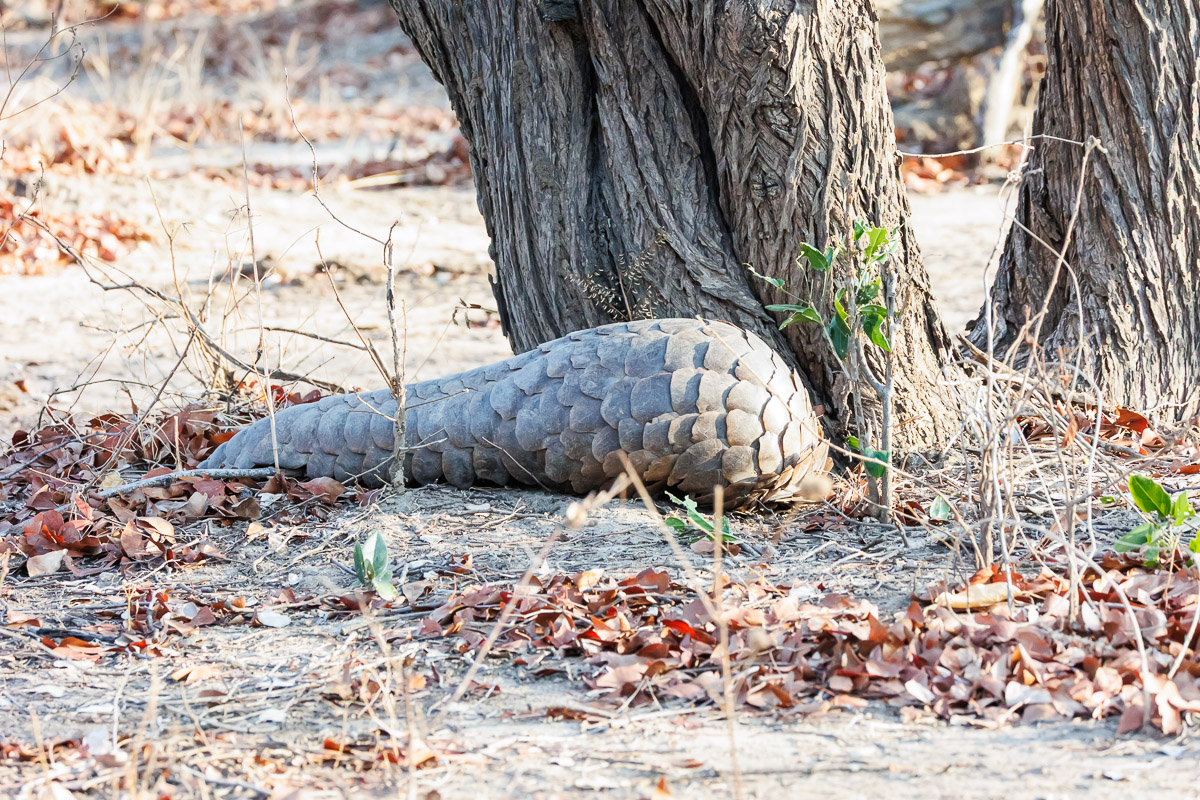
Not long after, we noticed two vehicles from another lodge speeding past us. A third stopped, and after a quick exchange between the drivers, Sam turned to us with a grin — a pangolin had been spotted. He quickly spun the vehicle around and we followed in hot pursuit. For ten long minutes we bumped along the track, wondering if we’d missed our chance. Then we arrived — and there it was.


Curled tightly around the base of a tree was a pangolin, its large protective scales gleaming in the morning light. It had rolled itself up defensively and wasn’t going anywhere. Pangolins are the only mammals with scales made of keratin — the same material as human nails — and are critically endangered. They’re also the most trafficked animals in the world, hunted for their meat and scales, which are falsely believed to have medicinal properties. Their scales can fetch as much as $3,500 per kilogram.

To see one in the wild was a privilege. These remarkable creatures have been around for tens of millions of years and can eat more than 70 million ants and termites a year with their astonishingly long tongues — longer even than their bodies. Sam, who had worked in the park for ten years, had never seen one before. Leonard had only encountered them when villagers found one and called for help to return it to the park. The pangolin truly is the “Holy Grail” of safari sightings.


We left it in peace and continued our drive, still buzzing with excitement. We saw plenty of birds, a large troop of baboons, and a couple of big crocodiles lounging in beds of water hyacinths — a surprisingly beautiful scene. No big cats this time, but after a morning like that, we didn’t mind. A large herd of buffaloes was the final highlight before our coffee stop.


We pulled up beside the river, where a flock of open-billed storks was feeding along the bank. These almost black storks have a distinctive gap between their bill tips, which they use to extract snails and mussels from their shells. We also spotted a Western Banded Snake Eagle — a rarer sight here than its more common Brown cousin — and a huge flock of Lillian’s Lovebirds. These small, bright-green parrots with red bills, white eye-rings, and orange-red faces were chattering noisily as they flitted between trees.


Bee-eaters were everywhere too — Bohm’s, Little, Swallow-tailed, and European — adding flashes of colour to the riverine woodland. Before coming to Malawi, I’d never seen a Swallow-tailed or Bohm’s Bee-eater. Both are beautifully localised and scarce, making the sighting even more special.

Far off, a herd of zebra grazed on the open plain — only the second we’d seen in Liwonde. They’re common in other African parks, but here they’re much rarer. A solitary sable antelope completed the morning’s sightings, its dark, glossy coat gleaming in the sunlight.

That afternoon, Sam took us to see Livingstone’s Baobab, one of Liwonde National Park’s most famous landmarks. The tree is steeped in history and legend, believed to have sheltered David Livingstone and his exploration party during their travels along the Shire River. Livingstone remains deeply respected in Malawi for his role in opposing the slave trade across sub-Saharan Africa.


The baobab itself is immense — estimated to be between 300 and 400 years old — and partially entwined by a strangling fig that’s slowly consuming it. There’s a small opening in the trunk that allows you to squeeze inside if you’re small enough. Sam and Leonard both managed it; we, however, decided to leave it to them.
Just outside the camp there are the bones of a hippo that had died in the camp and had to be transported outside for obvious reasons. It gave you a real insight into how big these creatures are.

As the sun began to set, we stopped to admire the view. The silhouette of a distant elephant was framed against a wash of orange sky — one of those timeless African scenes that never fail to stir something deep inside.


Warthogs were everywhere in this area, tails upright as they trotted through the grass, and to our amazement we also spotted a bushpig — the first we’d ever seen. With their coarse, reddish-brown fur and shy, nocturnal habits, they’re much less frequently encountered than their warthog cousins.

As night fell, Leonard swept his powerful torch across the bush. Eyes glinted in the dark — genets, their long ringed tails disappearing into the shadows as they hunted for small mammals and insects. A scrub hare froze momentarily in the beam before bounding away into cover.


Back at camp, we were greeted once again with a cool towel and a glass of sherry before dinner. The food, as always, was delicious, and by now the sounds of the bush were in full chorus.
We’d become a bit blasé about needing a ranger escort back to our tent — until that night. Halfway along the path, the torchlight caught a massive hippo grazing just ahead of us… and then another. The ranger shouted, and they turned and ambled away, apparently unbothered. They may seem placid, but hippos are responsible for more human deaths in Africa than any other large animal. Still, these ones must have been accustomed to the camp’s comings and goings.


It was a fitting end to an extraordinary day — a reminder that in the wild, every night holds its own surprises.
Thursday 23 October
It was time to return home and we had a long trip ahead of us, starting with a thirty-minute boat ride back to the park gates. There we were met by our driver, the same friendly face who had taken us to Pumulani at the start of our journey.
The drive from Liwonde National Park to Lilongwe Airport took around six hours, passing through busy towns and small villages such as Balaka and Zombe. We made a short stop for coffee, conscious that time was tight and that Lilongwe traffic can be notoriously unpredictable. Once again, we were pulled over by the police for speeding — something that seems to happen to most drivers here. As our driver dealt with it, we sat quietly in the car, hoping it wouldn’t take too long. Fines are issued on the spot, though corruption among traffic police officers is said to be increasingly common.
Eventually, we reached Kamuzu Airport with plenty of time to spare. It seemed there were only two international departures that day: a Kenya Airways flight to Manchester and our Ethiopian Airlines flight to Heathrow. The first leg to Addis Ababa was on a cramped Boeing 737 — a rather uncomfortable few hours. We then had a five-hour layover in Addis Ababa Airport. With a pint of Heineken costing $18, we decided not to make a habit of drinking there, but reluctantly bought two and made them last.
Finally, we boarded the last flight — a much newer and far more comfortable plane bound for Heathrow. It was quite a bumpy journey, but the skies were beautifully clear. At one point, I woke to see a vast city below, its lights glowing in intricate patterns. Checking the onboard map, we were somewhere over Greece. Perhaps it was Athens — I wasn’t entirely sure.
Our trip to Malawi had been unexpected but truly wonderful. In just a few days, we had experienced the beauty of the lake and two very different national parks, as well as glimpses of the country’s culture and daily life. Malawi is undeniably poor and faces many challenges, corruption among them, but it also has an extraordinary warmth about it. Sustainable tourism could offer hope here, especially for travellers seeking authentic wildlife experiences away from the crowds.
Game viewing may not be as effortless as in some other countries, but that only made each sighting more rewarding — especially knowing we often had it all to ourselves. Seeing a pangolin was an unforgettable highlight, something few tourists are lucky enough to witness. More than anything, we experienced the friendliness and hospitality that have rightfully earned Malawi its nickname: the “Warm Heart of Africa.”