Saturday 8 February 2025
Arrival at Mandina Lodge

For some winter sun in February we decided on The Gambia a small West African country completely surrounded by Senegal. It is known for its incredible birdlife and its great weather at this time of year. With no oil or precious minerals to fight over it has enjoyed a reasonably stable existence although it is one of the poorest countries in the world for the same reasons. Despite the presence of the Gambia river, which runs through the middle of the country, only one-sixth of the land is arable, and poor soil quality has led to the predominance of one crop – peanuts. Tourism is an important source of foreign exchange and the country enjoys visitors from Germany and Holland in particular as well as from the UK.

It had been a five and a half hour flight from Gatwick to Banjul on Titan Airways; a no frills charter airline that is used by Gambia Experiencer our travel company. There were no screens for entertainment and food consisted of sandwiches but as it was a reasonably short and a daytime flight this really didn’t matter.

The airport at Banjul was small and ours appeared to be the only flight. This meant getting through customs was a pretty painless affair. We airport paid our tax in sterling as we couldn’t get the local currency (the Dalasi) before we arrived and realised immediately that it was a nice little earner. The 200 Delasi note we received as change meant we paid well over the odds compared to what we would pay in local currency. Next we needed to exchange sterling for Delasi. Having seen on the airport website that there was a bank we thought that was where we would go, but to our surprise we were guided through the airport to a corridor where there were two opposing money changers. We were warned to count the notes we received before we left the airport, but this was not an easy task as the largest note is only a 200 and we needed lots of local currency as the first lodge only took cash. After bartering on the exchange rate great piles of orange notes were stuffed into our hands with no chance of checking the amount and even less chance of stuffing the huge piles into our wallet. All in all a rather stressful experience but incredibly after a quick count on the coach, it appeared that we had been given the correct amount of currency.

We arrived at Mandina Lodge after a slow journey from the airport as the traffic was horrendous. It was a mixture of yellow taxis, colourful vans, large trucks and even the odd donkey and cart. Although the main tarmac road was single lane, a sandy road ran alongside and most people used this as a way to get past the queuing traffic. Two things stood out for sale as we passed brick shacks that served as shops. The first were the huge and ornate iron gates that were and the second were the massive carved wooden bed frames. Both these items were in complete contrast to the other more simple items on sale. Sadly rubbish was a problem here with the usual plastic bags and other plastic debris just dumped at the side of the road despite anti-littering laws and a plastic bag ban since 2015. We passed by beautifully dressed ladies in colourful dresses and scarfs. The country is 80% Muslim with Mandinka making up the largest ethnic group in The Gambia. The Mandinka converted to Islam in the 19th century.

The Mandina Lodge was located by a tributary of the River Gambia in the heart of the Makasutu Forest. We had one of the Jungle Lodges which was huge. The lodge was the result of 20 years’ hard work by two Englishmen, James English and Lawrence Williams. Today Linda English, James’ widow now runs the lodge helped by a multitude of local workforce.

We returned to our room after a drink at the bar and dinner to find a big flat spider several inches across in the middle of the floor. Being an arachnophobia I was horrified although at least because of its flattened appearance it looked more like a crab than a spider. I found out later that it was a wall crab spider often known as “flatties” because of their dorsally flattened bodies. These spiders are harmless to man but in my defence I didn’t know that at the time. I got Andy to tread on it but to my horror it scuttled off under the bed. That night I made sure that our mosquito net was secure frightened that the spider might come back in some revenge attack, but we never saw it again.


First Day at Mandina Lodge
At Mandina, each couple had their own guide and we had Mass assigned to us. It was an early start with tea being brought to our room. We had a walk through the local forest to an area used for paddy fields. As it wasn’t the wet season the ground was being used to grow vegetables. It was like a lot of individual allotments each separated from each other by makeshift fencing. The area was a haven for birdlife. It was also hot and quite muddy. At one point we had to cross over some water by balancing on stepping stones. These days I’m not that good at balancing so I had to be helped by the guide.

There were lots of sunbirds flitting around the bushes. We spotted a Scarlet Chested Sunbird as well as the aptly named Beautiful Sunbirds. The sunbirds are so attractive that many of them are named with superlatives including the Splendid and Superb Sunbirds. We were also lucky enough to see a Lizard Buzzard although it was trying its best to hide from us in the leaves of a thick tree.


There were also lots of Red-billed Hornbills and a Pied Hornbill. Other birds we spotted were Senegal Wattled Lapwing with their distinctive yellow wattles and legs and the Senegal Coucal. Overhead a Hamerkop flew and landed in the water near us. It really does have a head like a hammer and is a strange top heavy bird known for building huge nests. There were also lots of Cattle Egrets attracted by the wetlands and of course the cattle. We saw a small herd being led by a very young boy who couldn’t have been more than 7 or 8 and I wondered how safe he was as anything could happen to him. Mass was quite angry and said how irresponsible it was of the parents.

There were a few Green Vervet Monkeys around up in the trees eating the fruit and later we saw more at the lodge. We noticed that when the tide was out the monkeys liked to catch the crabs that scuttled around the mangroves.

In the evening we went for another walk this time to see the baboon troupe nearby. Thanks to the founders of Mandina Lodge the reforestation that they did has encouraged these baboons to return. There are in fact five species of baboons of which those in The Gambia are the smallest and are Guinea Baboons. They differ in colour to those I had previously seen in Southern Africa and were a more reddish-brown than the grey of their cousins. There are about 200 individuals in the troupe and we spotted some really young babies. I could watch baboons all day as they are so entertaining.

We also spotted an African Harrier Hawk with its distinctive striped underwing pattern and some Western Plantain Eaters a type of turaco.

We also saw our first Giant Kingfisher which as the name implies is a massive black, white and chestnut kingfisher that patrols the river hunting fish, crabs and frogs.

A Yellow- crowned Gonolek was another highlight with its striking crimson chest and yellow head. It is affectionately known as the German flag bird as its colours are the same.

At dinner we were entertained by a young man playing the kora. The kora is built from a gourd, cut in half and covered with cow skin to make a resonator with a long hardwood neck. The skin is supported by two handles that run underneath it. It has 21 strings, each of which plays a different note and in that respect is more like a harp than a guitar. It was lovely to hear it played and I imagine quite a difficult instrument to learn.


Boat rides on the River Gambia
Sunday 9 February 2025

In the morning we did a boat ride. There was just thetwo of us in a paddle canoe with our guide paddling with an oar. Not the most comfortable of rides but lovely to quietly float up the river. There were lots of river birds – egrets and herons. There were also Pied and Malachite Kingfishers.

We passed by another lodge which apparently only takes Dutch and Gambian guests. The only clue to it being there was the long wooden pier.

We got off the boat at an oyster farm. Oysters are collected at low tide and then boiled in big pots to be sold at market. There were huge piles of oyster shells being picked over by vultures. The shells are crushed and used to make a kind of wall cement.

Walking round the area we saw lots of birds and a huge Silkwood tree. It is iconic in Gambia and can reach heights of 200 feet. This one was pretty high and dwarfed us as we stood beside its giant trunk and buttress roots. In Gambian culture, it holds immense importance and is considered a sacred tree imbued with spiritual significance. It is believed to be the dwelling place of ancestral spirits, and as such, it is treated with reverence and respect. It is also of great importance to birds and animals with its nectar rich flowers attracting bees and butterflies. The fibres of its seed pods and bark are known as kapok and are used as a filling for pillows and mattresses.

There were also Baobab Trees here. It is an unmistakable tree with its huge trunk circumference where it has adapted to the dry season by absorbing water during the rainy season. No wonder it is known as the ‘Tree of Life’.

Noisy, vibrant green Rose- ringed Parakeets screeched from the tree tops, almost hidden by the foliage of the trees they were in. Looking up we also saw a huge bees nest attached to an overhanging branch. We could see the bees around it and its position meant that the local’s couldn’t access the honey as it was too far along the tree branch.

We visited a family who had a Northern White-faced Owl in a tree in their garden. It is quite a small owl with a pale face set off by yellow orange eyes. It was very aware of our presence and had its eyes open. At one point it made itself look a lot bigger by pushing up its ear tufts a clear sign that we needed to leave him be.

Meals were good at the lodge and consisted of three courses. I particularly loved the soups. The chef called Ba was such a nice guy, insisting on being in his chef whites before he would take our order for dinner. We had to pre order from the menu at 4, before we went out for the evening tour.

In the evening we had booked the sunset cruise which involved a trip in a motor boat right up to the river mouth and to the edge of the Atlantic Ocean. There was also a bottle of wine that came with the cruise. The motor boat captain was called Dixie and he was lovely. I’d seen him earlier sitting down at the dock and I assumed he was just chilling before it was time to take us. Our guide Mass also came.

There were lots of Egrets and Herons around as well as the ubiquitous Kingfishers. Ospreys were out too and we watched as one flew over with a fish firmly attached to its claws. For the first time we saw Pink-backed Pelicans which are much smaller than the Great White Pelicans we were used to seeing. There was also a beautiful pair of Blue-cheeked Bee-eaters posing for us on a dead branch.

Large eyed Senegal Thick-knee stood motionless on the shore blending in with the sandy soil. Their large yellow eyes accentuated by their black outlines as though someone had gone round them with a thick kohl eyeliner pencil. Nearby we spotted our first crocodile a large specimen sunbathing on the bank. Our approach startled him and he slid into the water with a resounding splash.

Finally the river opened out and we knew we had reached the Atlantic Ocean. Almost immediately the swell of the water felt different and a lot stronger. Having looked out into the ocean for a few minutes the boat made a U-turn and we made our way back downstream to the lodge and dinner.


Three Reserves
Monday 10 February 2025

Today we did a trip to three local reserves – Pirang, Bonto and Farasutu. Our first stop was Pirang. We took a taxi with our guide Mass. The taxi was pretty decrepit with more warning lights on the dashboard than Crystal Palace so there was no surprise when it wouldn’t restart after we stoped to see an eagle on route. Mass seemed unfazed and we just left the taxi stranded on the road. Incredibly the driver managed to restart the car and he was able to pick us up from the walk later.

The walk took us past extensive salt flats. There were a few Greater Flamingos on the water although the majority arrive in December, also Spoonbills, Pelicans and lots of waders. We also noticed a lot of Swallows flying around attracted by the insects around the water. In the shallows rows of Caspian Terns stood, unmistakable with their bright red bills and there were Avocets, Ringed Plovers, Whimbrels and other shore birds. Many were a familiar sight in the UK and somehow it seemed strange seeing them here so far from our shores. There was a nearby shrimp farm and we watched the ladies walk down to fish. The temperature was ideal for walking and it was flat so not quite the arduous walk that we thought it might be.

As we walked further we spotted a pair of Yellow-billed Storks on the opposite bank. In the trees along the bank groups of Blue-cheeked Bee-eaters flew around. Overhead we saw lots of birds flying including groups of Pink- backed Pelicans, Spoonbills and Yellow-billed Storks.

As we walked back to the waiting taxi the heat was already increasing as the sun rose in the sky. I was thankful that we’d done the walk in the coolness of the early morning. It was a short car ride to Bonto National Forest where we got out and waited patiently for the young local guide to finish her breakfast. I was pleased to see that she was a women as guiding appeared to be mainly for the men here. She led us through the forest pointing out potential trip hazards as she obviously thought I was likely to be a bit of a liability! After about five minutes we stopped by a large tree and she pointed out the huge owl that was roosting up there. It was a huge Verreaux Eagle Owl, the largest owl in Africa. It is named after Jules Verreaux, a well-known ornithologist and botanist in the 1800s. The first thing that struck me were the pink eyelids that looked like they had been painted on. The owl must have been over two foot high and it stared down at us with its dark eyes. We were lucky that it was awake and facing us as many visitors are left with its back facing them which would have been so disappointing.

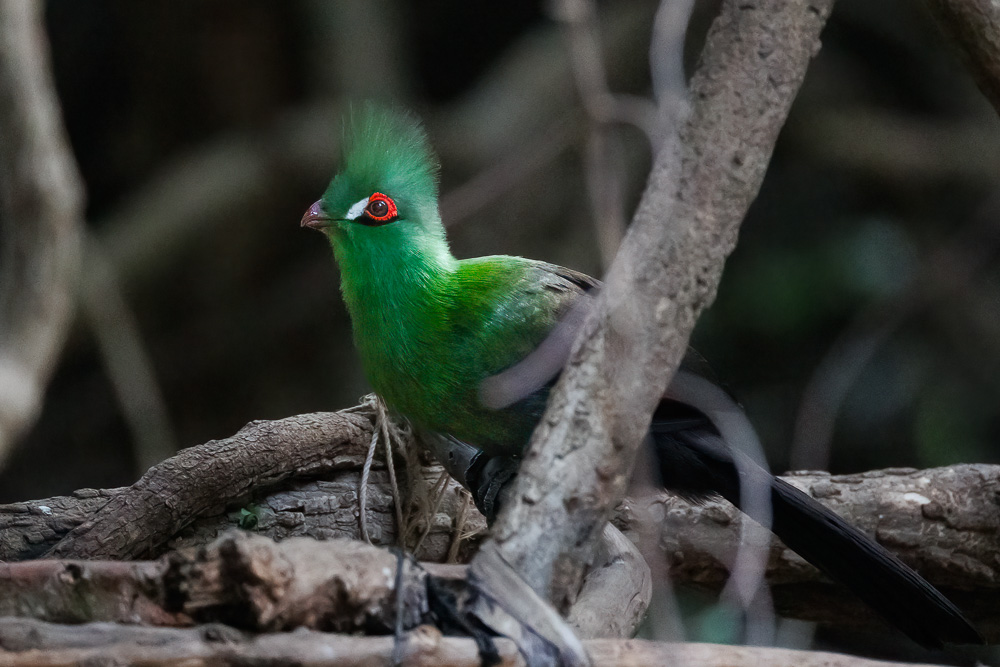
Our final stop was Farasutu a small forested area home to many bird species. We started the tour by sitting at a small viewing area. The number of birds that came down to drink were incredible. There were Paradise Flycatchers, Brown Babblers, Red-cheeked Cordonbleu, Weavers and Lavender Waxbills. The highlight though was a Green Turaco a beautiful bird with a crest of feathers on its head. Turacos are the only birds to possess true red and green colour. When you look at most birds, the colour you are seeing is a reflection produced by the feather structure. The turaco’s red pigment (turacin) and green pigment (turacoverdin) both contain copper.

We were then taken to see a Grayish Eagle Owl. The owl was high up in the tree but luckily we had a good view. It had incredibly dark eyes and they were open which is always a bonus when you photograph them.

It was then quite a long walk to a piece of scrub that contained Long tailed Nightjars. They were incredibly difficult to spot blending in perfectly with the leaf litter. Without a guide there would have been no way that I would have seen them. We were fortunate to see them too, as another group from the lodge had been told that they weren’t visible a few days before.

We got back at 1pm but our guide tried to make out that we needed to pay more to the taxi driver as we were later than 12 o’clock and that constituted a whole day. Luckily Andy wasn’t having any of it and had remembered that it had said that we would return at 1 in the excursion description.

We did another boat ride in the afternoon but there was not much around. The highlights were a Blue-breasted Kingfisher and a Palm-nut Vulture. The Palm-nut Vulture was very different to the other vultures we had seen. It was mainly white in appearance with red bare facial skin and yellow eyes.

It was our last night and we had really enjoyed Mandina Lodge although rather sadly we had missed not having WiFi. There had been so many times when I had wanted to look something up and hadn’t been able to. Everyone had been so friendly too. With it being such a small lodge there weren’t that many of us. All the guests were from the UK except for a group of four Germans.

The food had been good particularly as they are very much out in the sticks so sourcing it must be very difficult. At meal times we were often entertained by the large fruit bats that had made their home at the top of one of the tall thatched structures that made up the roof of the restaurant. The bats were Gambian Epauletted Fruit bats.


off to Senegambia
Tuesday 11 February 2025

It was our last morning around Mandina Lodge before we transferred to our next hotel. We got up early and walked around seeing if there were any birds to photograph. We spotted the beautiful Blue-breasted Kingfisher again hunting off the mangroves close to the lodge.

We also spotted a Brown-throated Wattle-eye a lovely black and white bird with a bright scarlet patch of bare skin above its eye.

There was also a lovely Western Reef Heron fishing in the shallow waters by the lodge.

Then it was time to leave and transfer to the Senegambia Hotel in Kololi. There was just one minibus and it proceeded to drop everyone off to their next hotel or for one couple the airport. The Senegambia was a huge sprawling hotel with two pools situated next to the beach. It couldn’t have been more different than the Mandina Lodge. We had been attracted to come here because of the large garden that attracted lots of birds.
We spotted a small group of Red Colobus Monkeys high up on one of the hotel roofs. Throughout the week we often saw either these or Green Vervet Monkeys. I’m sure they saw the hotel as an easy place to get food but at no time did they seem a real nuisance.
We were taken to our small rather basic room and were initially very underwhelmed but as the week went on the hotel did grow on us. It was in a very good position next to the beach and near the area known as the ‘Strip’ where there were lots of restaurants and bars. There was also WiFi.
We decided to explore the ‘Strip’ and were immediately descended upon by a variety of people all eager to take us on a tour or suggest a restaurant or bar. They all wanted to know our names so that next time we set foot out of the hotel they could call out to us. The place was buzzing and full of atmosphere, with a mix of locals and tourists. There were lots of money changing booths and places to book tours as well as a market selling souvenirs.

We decided to watch a rerun of the England v France rugby game and bought some crisps and a few bottled beers from the local minimart. We ended up normally having Goldfinch or Cristal beers both brewed locally. After watching the game we returned to the strip and decided on a dinner of chicken and beef fajitas which was very nice.


Around Kololi
Wednesday 12 February 2025
It was our first full day at the Senegambia Hotel and we woke up early for the included breakfast which was pretty good. There was cooked breakfast if you wanted it and the ubiquitous egg person who could create any kind of egg you wanted be it omelette, scrambled or fried.

We walked around the hotel gardens and down to the beach. The beach was equipped with lots of sunbeds but it was pretty clear that you needed to get down to the beach early to secure one.

At 11.30 each day the hotel does a Vulture Feeding. The birds obviously become used to this so loads of Hooded Vultures strutted around the garden or waited patiently in the trees. The large green where they feed them also has a small man made water hole for them. Also in evidence were Black Kites. They weren’t on the ground but high in the trees or wheeling around the green as they knew there was food to be had if they were quick enough. Eventually a small crowd of spectators formed and a hotel employee came out with a tray of food. As the food was thrown out to the waiting birds the skies filled with kites and vultures and it made for an incredible display. There was also a brief talk on the vultures and we were told that the pink headed ones were the adults and the grey headed ones the juvenile vultures. Although not the prettiest bird they are incredibly important to the ecosystem. They are carrion feeders eating animals that are already dead so stopping diseases that can be caused by rotting carcasses. They can eat meat even if it is rotten as they are able to tolerate it as their acidic stomachs kill off harmful bacteria.

We girded our loins and stepped out onto the ‘Strip’ once more. We walked around to the craft market and were immediately overwhelmed by the different stall holders wanting your custom. The stalls were filled with dye bags, wooden carvings, drums, scarfs and t- shirts.

Late afternoon we walked around the gardens but there weren’t that many birds around. We mainly saw Western Red-billed Hornbills, Snowy-crowned Robin-Chats and Long-tailed Glossy Starlings.

In the evening we found a local restaurant called ‘African Queen’ and had a lovely meal. It was also a great place to people watch. One particularly colourful character was a Rastafarian Biker who posed outside the restaurant. Even his leathers sported the Rastafarian colours of red, gold and green.


Kotu Creek
Thursday 13 February 2025

Today we had booked to do a bird tour with the guide based at the Senegambia Hotel called TJ. We took a short taxi ride to Kotu Creek. We got out and walked down a sandy path and almost immediately we spotted a small group of Hadada Ibis feeding on the scrubland adjacent to where we were walking. There were lots of birds here with the bushes filled with weavers that flew in small flocks feeding on the insects. A Turquoise Abyssinian Roller posed for us on a bare branch and there were lots yellow billed shrikes clinging to the knobbly trunks of the palm trees.

Then there was the unmistakable tapping of a woodpecker and we spotted the red head of an African Gray Woodpecker clinging to the side of a tree furiously hammering with its beak to prise out grubs and insects.

We also saw a Green-backed Camaroptera, a small wren like bird with beautiful olive green wings, although getting a photo proved anything but easy as it clambered through a thorny bush.

Another first was a Broad-billed Roller, not as brightly coloured as its cousins with dark cinnamon brown plumage and a chunky yellow bill.

We also had better views of an African Harrier Hawk up in a tree. We could actually make out its distinctive yellowy-pink face. Apparently they have double-jointed knees which allow them to access nest holes and other confined spaces. The last one we’d spotted had been hanging by its beak from a palm tree. They often climb using both wings and feet. The colour of their face can change from yellow to red during aggression and courtship.

The guides obviously knew there was a Pearl-spotted Owlet in the area and eventually TJ located it in a nearby tree. It was a small roundish owl with large yellow eyes. This particular individual looked quite puffed up as though he’d just enjoyed a very large meal. They have white-ringed, black blobs on the back of the head to give the impression of “false eyes”. Presumably this deters predators and mobs of small birds from attacking from behind.

The area was very marshy and we had to be careful where we stepped. We followed the path TJ took taking care not step outside where he went, wary that we could end up sinking to our knees in mud. There were lots of Beautiful Sunbirds in the bushes their colourful plumage shimmering in the sunlight. A couple of Senegal Coucals showed well. They are part of the cuckoo family but don’t rely on other bird species raising their young.

Suddenly TJ spotted something in the bushes, a flash of turquoise and we saw our first Woodland Kingfisher. It is smaller than its cousin the Blue-breasted kingfisher and doesn’t have the black patch on its back or the blue breast. We got a good view of it and it perched in the open for quite a long time allowing for some good photos.

There was a path made of old sand-filled tyres that led to a small hide. It wasn’t that easy to walk along them but eventually we reached the wooden hide. Another couple were already there. They pointed out a Jack Snipe hidden in the mangrove roots. There was also a Malachite Kingfisher.

After our walk we were taken to the bridge at Kotu Creek to get our boat ride. As we waited we watched a Pied Kingfisher with his catch of a fish. It was smacking the fish against its perch to stun or kill its prey so that it made swallowing easier. The fish was then manoeuvred with its beak so that it could slide it head first down its throat.

A Common Sandpiper sat patiently on a wooden stanchion, another familiar bird from the UK. It watched on as I unceremoniously got into the canoe. Whistling ducks flew overhead in a large group.

As we floated slowly along we almost missed the huge Monitor Lizard basking in a tree. Long -tailed Cormorants were drying their feathers in the sun. Their feathers are not waterproof so when they dive for food their feathers soon become saturated. After a dive they need to dry the feathers off so that’s why you often see them with their wings outstretched.

There were lots of crabs in the mangroves playing a vital role in eating up any organic debris and recycling the nutrients. This helps keep the mangroves healthy.

We hadn’t been going far before we came across a small cement bridge. I assumed we’d have to turn back , but to my horror the captain told us to bend over as we were going under. Not wanting to put his feet in the few inches of water at the bottom of the boat Andy was struggling to get low enough. After cursing and dropping his cap he managed to get low enough and we both emerged with heads still intact.

With a canoe our progress was both quiet and slow and we were able to get incredibly close to the birds along the river bank. We were able to take some great photos because of our proximity. There were Pied Kingfishers on their look out perches, Malachite Kingfishers and Giant Kingfishers were also out patrolling the riverbanks for food. We even spotted a Senegal Eremomela on a branch overhanging the river.

As we moved further upstream we spotted a pair of Giant Kingfishers, a male and a juvenile. They were sitting on an overhanging branch. The canoe moved in quite near to them and they seem unfazed. I’m sure they get used to the boats.

As we walked back up to the main road we were still looking out for birds. There were small groups of foraging Red-billed Firefinches. The males are lovely with a red bill and plumage. The female was mostly brown with just a small patch of red under her eye.

Late afternoon we walked around the hotel again. There were lots of Western Red-billed Hornbills, Long-tailed Starlings and White-headed Robin-Chats. There were also groups of Green Woodhoopoe, the juveniles evident by their red bills. They were probing the bark of the trees for insects and small invertebrates. The highlight was a Western Plantain-eater.

In the evening we picked a restaurant almost next to the hotel. It had a really nice roof terrace and was a great vantage point for watching the people below.


Bijilo Monkey Park
Friday 14 February 2025

Today we decided to go to Bijilo Monkey Park. It was a 25 minute walk along the beach and of course we were met by someone who insisted that he be our guide and take us there, to be honest I’m not sure we would have found it without him, as it was further up the beach then we had thought. We bought the tickets at the entrance and nuts and bananas to feed the monkeys

We waited quite a long time for the monkeys to come. First to arrive were the Green Vervet Monkeys and then the shyer Red Colobus monkeys. In 2018 a portion of the park was destroyed in order to construct a conference centre. The whole park came under threat when the entire area lost its status as a reserve and it looked like the bulldozers were going to move in again, but thanks to the protest of many dedicated people including the environmentalist group ‘Green up Gambia’ and the thousands of people who signed a petition this decision was overturned and the parks reserve status reinstated.

A bore hole was created after the water hole the monkeys relied upon was destroyed when the conference centre was built. We managed to lose our guide as he was feeding all of our peanuts to the monkeys as well as eating them himself. We gave him a tip which he was quite happy with as it meant he could guide someone else here.

It was very easy to navigate around the park as there was only one path it seemed. The Green Vervet monkeys seemed mush keener on the bananas that they grabbed from your hand. The Red Colobus were much more gentle and carefully reached out for the peanuts we offered. I always find these types of places difficult as I am split as to whether we should be feeding the animals as it makes them reliant on humans but I believe that they do need this extra food to survive.

On our way back we saw our guide again who was now touting the fresh fruit drinks sold on the beach. It seems that everyone here is a bird guide or can get you a taxi or a fruit drink. The Gambians are very resourceful. Agriculture is the main source of livelihood but tourism is incredibly important. Gambia’s only real exports are peanuts, fish and cotton. They are without the precious minerals and oil of other African countries, but this has probably meant that they haven’t had the conflict caused by these.

We had forgotten it was Valentine’s Day and ended up going back to the ‘African Queen’ restaurant to eat. They were putting on a special menu which was a bit more than we normally expected to pay, so Andy had to pop back to the hotel and get some more money. Cash is king here, we never saw anywhere that took cards. There were three incredible courses. The starters were shrimps in a filo pastry, the main a huge fish platter with Butterfish, prawns, lobster and crab and the dessert was pancakes with apple. It was all absolutely delicious.


Beach Day
Saturday 15 February 2025
We decided to do a beach day and got up early to put our towels down to secure a sunbed. It was not quite as warm as other days but it was still a perfect temperature. We watched the local fisherman in their small canoes out on the sea. This type of local artisanal fishing hasn’t changed for hundreds of years. Fishing is one of the major industries in the Gambia accounting for around 33% of the countries GDP. The Gambian fishing industry is facing challenges due to an increase in the presence of foreign industrial trawlers but have caused over fishing and the countries fish populations to decline to unsustainable levels.
There were lots of touts on the beach mostly selling juices. We bought a mango and banana juice and it was absolutely delicious. There were also women selling colourful beach wraps, shea and cocoa butter. Shea butter is a fat extracted from Shea tree nuts and is a common household product in Gambia. They use it for joints, dry skin, even sinusitis!
All of a sudden there was the unmistakable sound of a brass band playing and sure enough a small band came marching along the sand. Not quite what you’d expect on a beach.

The beach here is partially manmade with huge black rocks placed as a barrier to stop the waves from encroaching with imported sand behind. The red flag signifying no swimming fluttered the whole time of our stay but that didn’t prevent people from standing in the shallows although the waves were quite big. A few Cattle Egret patrolled the beach and the hotel cafe obviously finding enough titbits to sustain them. They had probably never encountered cattle!

We watched the vulture feeding once more this time trying to capture the birds in flight, but it was no mean task.

Later there was a traditional Gambian band playing on the green in the hotel which was nice but I could see they were getting guests involved so we stayed a fair distance away.


Back to Kotu Creek
Sunday 16 February 2025

We decided to get a taxi back to the marshland around Kotu Creek as it wasn’t that far. We tried to replicate the places we had been with the guide previously. We were lucky to see four White-faced Scops owls in a tree thanks to a guy who pointed them out. Three were in a group and one was in another part of the tree, unfortunately only one was properly facing us.

There were quite a few birds around including Black Kites who appeared to be nest building, often with long twigs in their beaks. Waders included Great White Egrets, Sacred Ibis and Squacco Heron. There were also a big group of Grey Herons. We spotted a Black-winged Stilt in a small pool by the road with its incredibly long red legs it really does look like it’s on stilts.

A beautiful Blue-bellied Roller was catching insects from its perch in a palm tree. You don’t appreciate how colourful it is until it flies and opens its wings.

There were a big family of pigs foraging in the grass and we saw Piapiac riding on their backs. The pigs obviously uncover insects for them to eat.

We decided to walk back as it wasn’t too far but had forgotten that we would obviously be prime targets for the touts, who could of course provide us with transport back to our hotel. We kept to the sandy road adjacent to the main road and soon the familiar sight of the ‘Strip’ came into view.

In the evening we chose a Dutch restaurant which was very nice and everyone was very friendly we even had a complimentary Sambuca at the end of the meal.


Final Day
Monday 17 February 2025
It was our final day so we decided to save a sunbed on the beach and have a chilled one. We decided to have an early walk in the gardens to see if there was anything about and were rewarded by quite a few birds right at the back of the garden where the solar panels were. Here the hotel backed onto a small piece of woodland and this was attractive to the birds.

There were a small group of Long tailed Glossy Starlings foraging about. We also had a great view of the Red-cheeked Cordonbleu a pretty turquoise coloured waxbill with a distinctive magenta mark on the cheek in the males. We also saw a Green-backed Woodpecker with its distinctive speckled markings.

For our final meal we returned to the ‘African Queen’


